
AD623 is a single-supply, rail-to-rail, low-cost instrumentation amplifier from Analog Devices, with features such as easy to use, higher performance than discrete design, single-supply and dual-supply operation, rail-to-rail output swing, input voltage range extends 150 mV below ground (single supply)
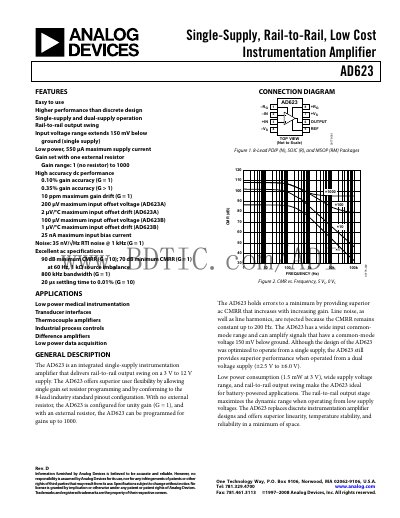
The AD623 is an integrated instrumentation amplifier that operates from a single 3 V to 12 V supply or dual +2.5 V to +6 V supplies. It provides rail‑to‑rail output swing, low power consumption (≈1.5 mW at 3 V), and a gain that can be set with a single external resistor.
Typical applications include low‑power medical instrumentation, transducer interfaces, thermocouple amplifiers, and industrial process controls. The device offers high accuracy (0.10 % gain error at G=1) and low offset voltage (as low as 200 pV typical).
| Gain range | 1 to 1000 |
|---|---|
| Supply voltage (single‑supply) | 3 V to 12 V |
| Supply voltage (dual‑supply) | +2.5 V to +6 V |
| Input bias current (typical) | 25 nA |
| Bandwidth (G=1) | 800 kHz |
| Slew rate | 0.3 V/s |
The AD623 can be programmed for gains from 1 (no external resistor) up to 1000.
The typical input bias current is 25 nA.
At a gain of 1, the AD623 has a –3 dB bandwidth of 800 kHz.