
The AD8290 is a CMOS sensor amplifier with current excitation. It is suitable for bridge and sensor drives as well as portable electronics. The amplifier features low power consumption, low input bias current, high common mode rejection ratio, etc.
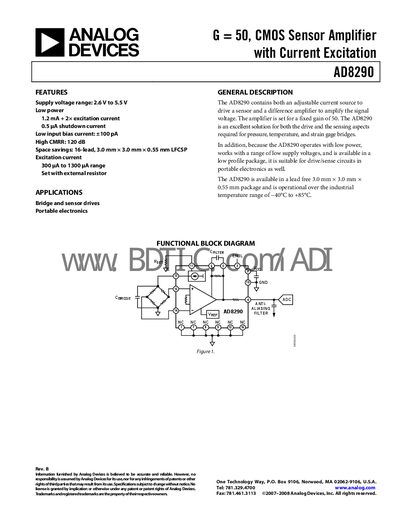
The AD8290 is a CMOS sensor amplifier with an integrated adjustable current source for driving bridge and sensor circuits. It provides a fixed gain of 50 and operates from low supply voltages, making it suitable for portable electronics and sensor interfaces.
The document includes electrical specifications, pin descriptions, typical performance graphs, and example applications such as pressure‑bridge and temperature‑sensor circuits. Package dimensions, ordering information, and layout recommendations are also provided.
| Supply voltage range | 2.6 V to 5.5 V |
|---|---|
| Quiescent current | 1.2 mA + 2× excitation current |
| Shutdown current | 0.5 µA to 10 µA |
| CMRR (DC) | 120 dB |
| Fixed gain | 50 |
| Input bias current | ±100 pA |
| Package | 16‑lead LFCSP 3.0 mm × 3.0 mm × 0.55 mm |
It operates from 2.6 V up to 5.5 V.
The typical DC common‑mode rejection ratio is 120 dB.
The amplifier provides a fixed gain of 50.
It is available in a 16‑lead LFCSP package measuring 3.0 mm × 3.0 mm × 0.55 mm.