
AD8230 is a low-drift, differential sampling, high-precision instrumentation amplifier. The auto-zero feature reduces offset voltage drift to less than 50 nV/°C. The AD8230 is well-suited for thermocouple and bridge transducer applications. The AD8230's high CMR of 110 dB (minimum) rejects line noise.
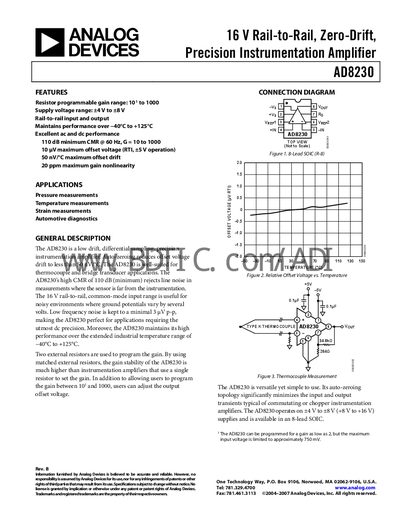
The AD8230 is a 16 V rail‑to‑rail, zero‑drift precision instrumentation amplifier designed for thermocouple, bridge transducer, pressure, temperature, strain and automotive diagnostic applications. It offers a programmable resistor‑set gain from 10 to 1000, excellent AC and DC performance, and a minimum 110 dB CMRR at 60 Hz.
The device operates from dual supplies +4 V to +8 V or a single supply +8 V to +16 V, and maintains performance over an industrial temperature range of –40 °C to +125 °C. Typical specifications include 10 pV maximum RTI offset, 50 nV/°C offset drift, 20 ppm gain non‑linearity, 15 mA short‑circuit current, and 240 nV/√Hz noise density at 1 kHz.
| Supply Voltage (Dual) | +4 V to +8 V |
|---|---|
| Supply Voltage (Single) | +8 V to +16 V |
| Gain Range | 10 to 1000 |
| Gain Nonlinearity | 20 ppm |
| Common‑Mode Rejection (CMR) | 110 dB minimum at 60 Hz |
| Input Offset Voltage (RTI) | 10 pV maximum |
| Input Offset Drift | 50 nV/°C |
| Short‑Circuit Current | 15 mA |
| Operating Temperature Range | –40 °C to +125 °C |
| Package Dimensions (SOIC‑N) | 5.00 mm × 4.80 mm (0.1968 in × 0.1890 in) |
The AD8230 can be programmed for a gain from 10 to 1000.
The device provides at least 110 dB CMRR at 60 Hz.
It is specified for operation from –40 °C to +125 °C.