
AD8214 is a fast, high common-mode voltage threshold detector, which operates with a single supply of 5 V to 65 V, and has a 10 mV hysteresis.
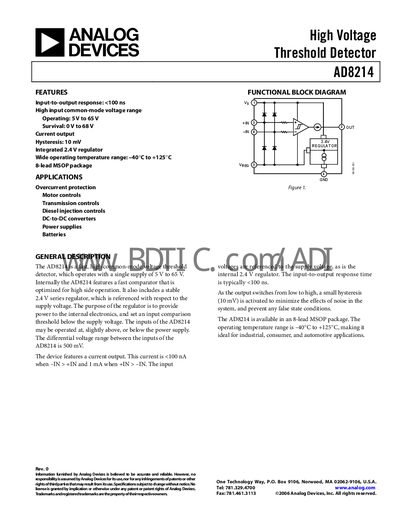
The AD8214 is a high‑voltage threshold detector designed for over‑current, motor‑control, and power‑supply applications. It features a fast comparator with <100 ns input‑to‑output response, a 2.4 V internal regulator, and a programmable hysteresis of 10 mV. The device operates from a single supply of 5 V to 65 V and can survive up to 68 V.
The datasheet provides full electrical specifications, absolute maximum ratings, pin configurations, and typical performance curves. Key specifications include a 10 mV hysteresis, -40 °C to +125 °C operating temperature range, and an output current up to 1.2 mA. Application notes cover high‑side over‑current detection and typical circuit setups.
| Input‑to‑output response time | <100 ns |
|---|---|
| Hysteresis voltage | 10 mV |
| Operating supply voltage range | 5 V to 65 V |
| Operating temperature range | -40 °C to +125 °C |
The typical response time is less than 100 ns.
The device includes a hysteresis of 10 mV.
It operates from –40 °C up to +125 °C.