
The DS4026 is a temperature-compensated crystal oscillator (TCXO) that provides ±1ppm frequency stability over the -40°C to +85°C industrial temperature range. The DS4026 is also available in Stratum 3 versions. Each device is factory calibrated over temperature to achieve the ±1ppm frequency stability. Standard frequencies for the device include 10, 12.8, 19.44, 20, 38.88, 40, and 51.84MHz. Contact the factory for custom frequencies. The DS4026 provides excellent phase-noise characteristics. The output is a push-pull CMOS square wave with symmetrical rise and fall times. In addition, the DS4026 is designed to provide a maximum frequency deviation of less than ±4.6ppm over 20 years. The device also provides an I2C interface to allow pushing and pulling of the output frequency by a minimum of ±8ppm (±5ppm for 10MHz) with typical 1ppb resolution. The DS4026 implements a temperature-to-voltage conversion with a nonlinear relationship. The output from the temperature-to-voltage converter is used to drive the voltage-controlled crystal oscillator to compensate for frequency change. The device implements an on-chip temperature sensor lookup table, and a digital-to-analog converter (DAC) to adjust the frequency. An I2C interface used to communicate with the DS4026 performs temperature readings and frequency push-pull.
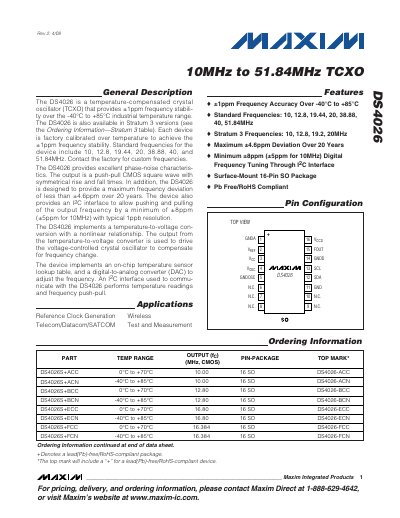
The DS4026 is a temperature‑compensated crystal oscillator (TCXO) that provides ±1 ppm frequency stability over an industrial temperature range of –40 °C to +85 °C. It is available in standard frequencies from 10 MHz to 51.84 MHz and in Stratum 3 versions, with a maximum frequency deviation of less than ±4.6 ppm over 20 years. The device includes a push‑pull CMOS square‑wave output and an I²C interface that allows digital frequency tuning with a minimum pull of ±8 ppm (±5 ppm at 10 MHz) and typical 1 ppb resolution.
The datasheet details absolute maximum ratings, recommended operating conditions, electrical characteristics, I²C serial interface timing, temperature‑sensor performance, pin descriptions, and functional block diagrams. It also explains the I²C communication protocol, register map, and recommended read/write procedures for temperature and frequency tuning registers.
| Frequency stability vs. temperature | ±1 ppm over –40 °C to +85 °C |
|---|---|
| Maximum frequency deviation (20 years) | < ±4.6 ppm |
| Standard output | Push‑pull CMOS square wave |
| I²C frequency tuning range | ±8 ppm (±5 ppm at 10 MHz) |
| Supply voltage (VCC) | 3.135 V to 3.465 V |
| Active‑supply current (typical) | 2.5 mA |
| Package | 16‑pin SO, surface‑mount |
| Temperature sensor resolution | 12‑bit, 0.0625 °C |
The DS4026 maintains a frequency stability of ±1 ppm from –40 °C to +85 °C.
The I²C interface allows a minimum tuning range of ±8 ppm (±5 ppm at 10 MHz) with a typical resolution of 1 ppb per LSB.
The device operates with a supply voltage between 3.135 V and 3.465 V.