
This document introduces the usage and functionality of the PID instruction, as well as its application example in temperature control. The PID instruction implements a PID algorithm with built-in auto tuning to determine PID parameters, and is designed for use with an analog I/O module for analog input reading and output control.
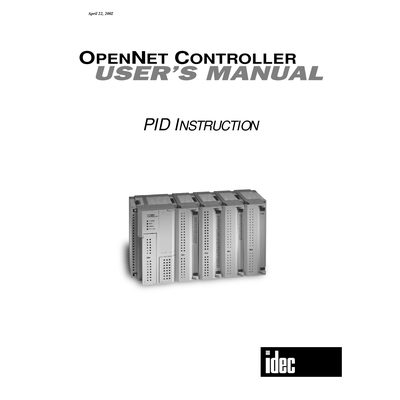
The PID Instruction manual introduces the proportional‑integral‑derivative (PID) algorithm built into the OpenNet Controller. It describes how the instruction works with analog I/O modules to read inputs, generate outputs, and perform auto‑tuning for parameters such as proportional gain, integral time, and derivative time.
The document details the required operands, valid data‑register ranges, linear conversion options, and the various operation modes (PID only, AT + PID, AT only). It also provides guidance on setting limits, alarms, sampling periods, and control periods, as well as troubleshooting tips for common errors.
| Maximum number of PID instructions | 42 |
|---|---|
| Output manipulated variable range | -32768 to 32767 |
| Sampling period register range | 0‑10000 (0.01 sec‑100 sec) |
| Control period register range | 1‑500 (0.1 sec‑50.0 sec) |
Up to 42 PID instructions can be used in a user program.
Emergency stop and interlocking circuits must be configured outside the controller; otherwise a failure of the process variable input may cause equipment damage.