
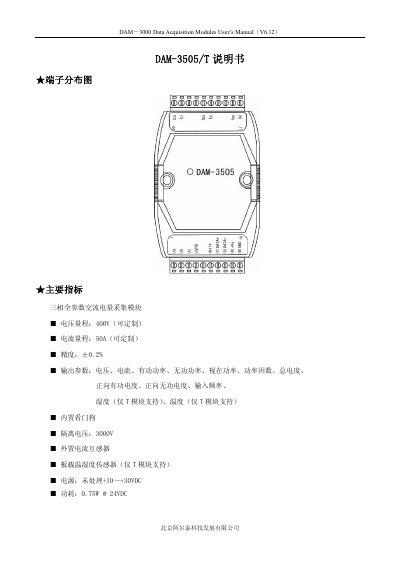
The DAM-3505/T is a three‑phase full‑parameter AC energy acquisition module designed for precise measurement of voltage, current, power and related parameters. This manual describes its main specifications, terminal assignments, and connection methods.
Key features include customizable voltage (400 V) and current (50 A) ranges, 0.2 % accuracy, built‑in watchdog, isolation voltage of 3000 V, and support for external current transformers and temperature/humidity sensors. The document provides code tables for baud‑rate configuration, terminal definitions, and wiring diagrams to aid installation and operation. This manual is written in Chinese.
| Voltage range | 400 V (customizable) |
|---|---|
| Current range | 50 A (customizable) |
| Isolation voltage | 3000 V |
| Power supply | +10 to +30 VDC |
| Power consumption | 0.75 W @ 24 VDC |
| External current transformer | Supported |
| Onboard temperature/humidity sensor | Supported on T module only |
The module supports a voltage range of 400 V, which can be customized.
Use the code configuration table: codes 00‑07 correspond to baud rates from 1200 to 115200 bps.
Terminals 1 (Ua), 2 (Ub) and 3 (Uc) are assigned to A, B, and C phase voltage inputs respectively.
It requires a DC supply of +10 V to +30 V.