
DAM6013 manual introduces the main features of DAM6013 3-way thermocouple input module, including resolution, input range, input wiring, sampling rate, input impedance, accuracy, zero drift, full scale drift, CMR, NMR, power consumption, etc.
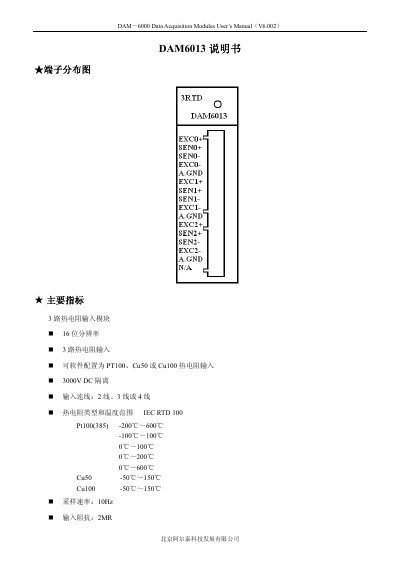
The DAM6013 is a three‑channel RTD data acquisition module that can be configured for PT100, Cu50 or Cu110 thermistor inputs. It provides up to 16‑bit resolution and supports 2‑wire, 3‑wire, or 4‑wire wiring with 3000 V DC isolation.
The manual includes detailed wiring diagrams, accuracy and drift specifications, power consumption data, and tables for configuring analog input ranges and code values. It also describes the module's performance metrics such as CMRR/NMRR and temperature range options. This manual is written in Chinese.
| RTD input channels | 3 |
|---|---|
| Input type | PT100, Cu50, Cu110 |
| Isolation voltage | 3000 V DC |
| Supported wiring | 2‑wire, 3‑wire, 4‑wire |
| Zero drift | 0.5 µV/TC |
| CMRR @ 50/60 Hz | 100 dB |
| Power consumption | 1.2 W (5 V supply) |
The DAM6013 module provides three RTD input channels.
The inputs can be wired in 2‑wire, 3‑wire, or 4‑wire configurations.
It consumes 1.2 W when powered from a +5 V supply.