
MAX8594 is a complete power management chip designed for low-cost personal digital assistants (PDAs) powered by 1 lithium-ion (Li+) battery or 3 NiMH batteries. It includes multiple regulators, outputs, and voltage monitors required for portable devices with only a few external components. The chip features three linear regulators, a boost-type DC-DC converter for LCD bias, an efficient 4MHz buck-type DC-DC converter for the core power, microprocessor reset output, and low-battery voltage shutdown function. The device is available in a thin QFN package with a height of 0.8mm.
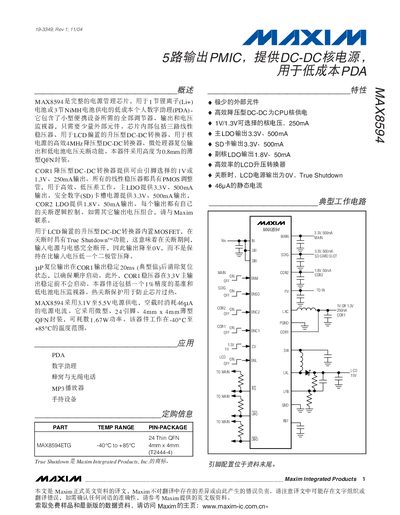
Maxim MAX8594 is a complete power-management IC for low-cost PDAs powered by one lithium-ion or three NiMH cells. It integrates regulators, outputs, and voltage monitors with few external components, including three linear regulators, a boost DC-DC converter for LCD bias, an efficient 4 MHz buck DC-DC converter for core power, a microprocessor reset output, and low-battery shutdown. The device is housed in a 0.8 mm high, 24-pin, 4 mm x 4 mm thin QFN package.
The COR1 buck provides a pin-selectable 1 V or 1.3 V output at 250 mA. The main LDO provides 3.3 V at 500 mA, the SD card slot power provides 3.3 V at 500 mA, and the COR2 LDO provides 1.8 V at 50 mA. The LCD boost converter has True Shutdown, so its output falls to 0 V when off. The device operates from 3.1 V to 5.5 V, draws 46 µA with no load, and is rated for -40°C to +85°C. This manual is written in Chinese.
| Supply voltage | 3.1 V to 5.5 V |
|---|---|
| No-load supply current | 46 µA |
| Package | 24-pin 4 mm x 4 mm thin QFN |
| Package height | 0.8 mm |
| Continuous power dissipation | 1.67 W |
| Operating temperature range | -40°C to +85°C |
| COR1 output | 1 V or 1.3 V, 250 mA |
| Main LDO output | 3.3 V, 500 mA |
| SD card slot output | 3.3 V, 500 mA |
| COR2 LDO output | 1.8 V, 50 mA |
| LCD boost output in shutdown | 0 V |
It operates from 3.1 V to 5.5 V.
It consumes 46 µA with no load.
The output falls to 0 V because input power is disconnected from the inductor.
It clears 20 ms (typical) after the COR1 output stabilizes.