
This document is about MITSUMI GPS Antenna GPA-CG2C2 product introduction. This product is a highly sensitive and efficient antenna for receiving GPS satellite waves. It is ideal for use as a built-in antenna for portable/handy equipment. The antenna pattern is custom designed to meet the customer's requirements.
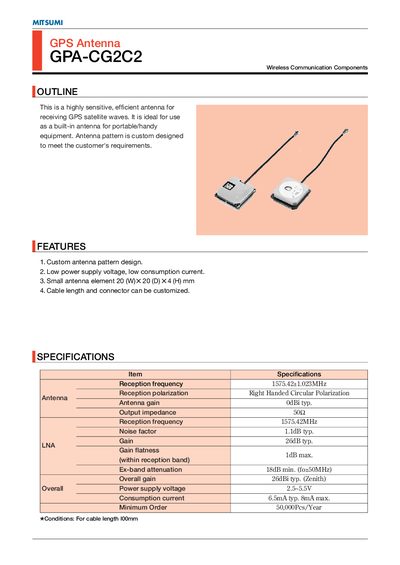
The GPA‑CG2C2 is a highly sensitive GPS antenna designed for portable equipment. It offers a custom‑designed antenna pattern and a small form factor (20 mm × 20 mm × 4 mm).\n\nKey features include low power supply voltage (2.5‑5.5 V), low consumption current (6.5 mA typical), and optional cable length and connector customization. The specifications list a typical antenna gain of 0 dBi, overall gain of 26 dBi at zenith, and a right‑handed circular polarization.
| Reception frequency | 1575.4241.023 MHz |
|---|---|
| Reception polarization | Right Handed Circular Polarization |
| Antenna gain | 0 dBi typ. |
| Output impedance | 50 Ω |
| Noise factor | 1.1 dB typ. |
| LNA gain | 26 dB typ. |
| Overall gain (zenith) | 26 dBi typ. |
| Power supply voltage | 2.5~5.5 V |
| Consumption current | 6.5 mA typ., 8 mA max. |
| Minimum order | 50,000 pcs/year |
The antenna operates from 2.5 V to 5.5 V.
Typical consumption current is 6.5 mA, with a maximum of 8 mA.
The overall gain at zenith is 26 dBi typical.
The antenna receives at 1575.4241.023 MHz.