
The document introduces the safety circuits of lithium-ion batteries, including overcharging, overdischarging and overcurrent protection circuits.
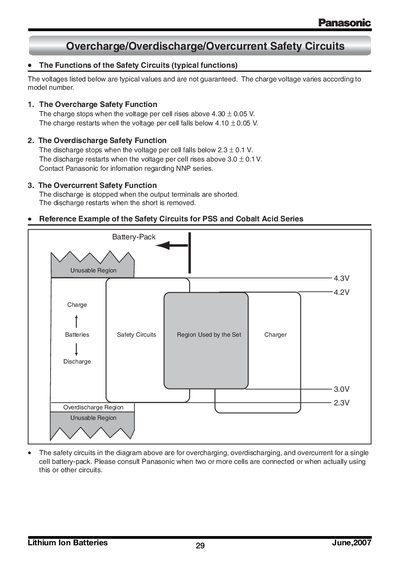
The document explains the safety circuit functions for lithium‑ion battery packs. It defines the voltage thresholds that stop and restart charging or discharging to protect against overcharge, overdischarge, and overcurrent conditions.
It also provides recommended charging parameters, including maximum charge voltage, charge current limits for different series, ambient temperature range, and the need for charge timers. A flowchart illustrates the charging sequence for a single‑cell pack.
| Overcharge stop voltage per cell | ≈4.35 V |
|---|---|
| Overcharge restart voltage per cell | ≈4.15 V |
| Overdischarge stop voltage per cell | ≈2.4 V |
| Overdischarge restart voltage per cell | ≈3.1 V |
| Maximum charge voltage | 4.20 V |
| Recommended ambient temperature range | 10 °C – 45 °C |
| Low‑voltage charge current limit | ≤0.1 It |
| Total charge timer threshold | 720 minutes |
Charging stops when the cell voltage rises above about 4.35 V.
The battery pack should be charged between 10 °C and 45 °C.
Discharge is stopped when the output terminals are shorted and restarts when the short is removed.