
PT5622 is a dedicated control chip for electronic ballasts, suitable for dimming products with ordinary switches. It features lamp current negative feedback control, programmable preheating time and frequency, etc.
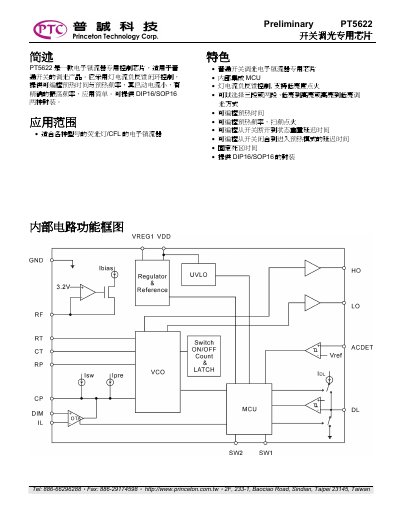
The PT5622 is a dedicated control chip for electronic ballast dimming applications. It uses lamp‑current negative‑feedback closed‑loop control, offers programmable pre‑heat time and frequency, and supports three‑ or two‑step dimming modes. The chip integrates an MCU and provides both DIP16 and SOP16 package options.
The document includes a functional block diagram, pin descriptions, working logic tables for various dimming configurations, electrical characteristic limits, mechanical dimensions for both DIP and SOP packages, and ordering information. An important notice from Princeton Technology Corporation outlines product revision rights and liability. This manual is written in Chinese.
| Supply voltage (VDD) | 13 V |
|---|---|
| Operating temperature range | -40 °C to +85 °C |
| Storage temperature range | -65 °C to +150 °C |
| Package types | DIP16, SOP16 |
| Reference voltage (RF) | 3.2 V |
| Pin count | 16 pins |
The chip is offered in two package styles: DIP16 and SOP16.
It operates from –40 °C up to +85 °C.
The normal operating supply voltage is 13 V.