
The German railway 407 high-speed train is a high-speed train based on the Velaro platform with a maximum operating speed of 320 km/h, a train length of 200 m, an electrical system of 15 / 25 kV AC and 1.5 / 3 kV DC, and a traction power of 8,000 kW.
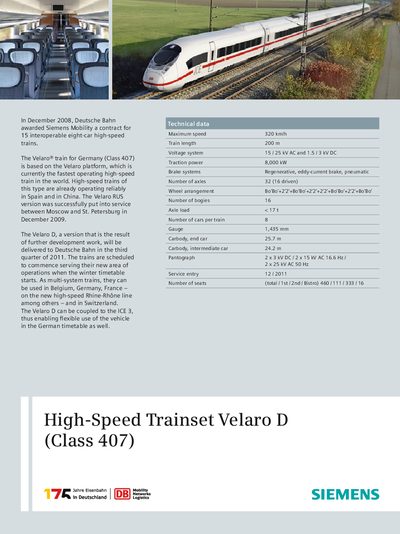
The Velaro D is a multiple‑unit high‑speed train developed by Siemens Mobility for Deutsche Bahn. It features distributed traction modules under the floor, allowing a spacious passenger area and a modular interior that can be adapted for different service needs. The train operates on 15/25 kV AC and 1.5/3 kV DC systems, enabling cross‑border service in Belgium, Germany, France, and Switzerland.
Technical data include a maximum speed of 320 km/h, a 200 m train length, and a total traction power of 8,000 kW. The train uses regenerative, eddy‑current and pneumatic brakes, and its design reduces energy consumption by about 10 %. Passenger comfort is enhanced by a low‑noise interior, video information screens, and an efficient onboard power supply system.
| Maximum speed | 320 km/h |
|---|---|
| Train length | 200 m |
| Voltage system | 15/25 kV AC and 1.5/3 kV DC |
| Traction power | 8,000 kW |
| Brake systems | Regenerative, eddy‑current, pneumatic |
| Number of axles | 32 (16 driven) |
| Axle load | <17 t |
| Number of cars per train | 8 |
| Gauge | 1,435 mm |
| Number of seats (total/1st/2nd/Bistro) | 460 (111/333/16) |
| Service entry | December 2011 |
| Pantograph configuration | 2×3 kV DC / 2×15 kV AC 16.6 Hz / 2×25 kV AC 50 Hz |
The Velaro D can reach a maximum speed of 320 km/h.
Each Velaro D trainset consists of eight cars.
The train uses regenerative, eddy‑current, and pneumatic brake systems.
It can operate on 15/25 kV AC and 1.5/3 kV DC power supplies.