
Technical specifications for Yokogawa EJA438W/EJA438N diaphragm‑sealed pressure transmitters, including ranges, outputs, installation and certifications.
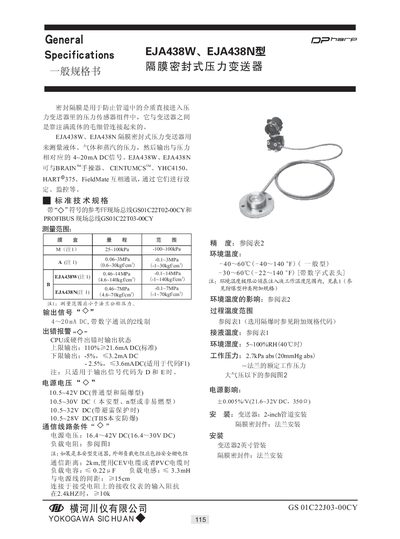
This document provides the full technical specification of the Yokogawa EJA438W and EJA438N diaphragm‑sealed pressure transmitters. It describes measurement ranges, output signals, power requirements, accuracy, environmental limits and the various optional codes for materials, flanges and explosion‑proof certifications.
Installation details cover flange dimensions, mounting options, cable connections and recommended procedures for zero‑adjustment and calibration. Certification tables list compliance with IECEx, ATEX, FM and other safety standards. This manual is written in Chinese.
| Output signal | 4–20 mA DC, digital communication (BRAIN, HART, FF, PROFIBUS) |
|---|---|
| Power supply voltage | 10.5–32 V DC (10.5–30 V for intrinsically safe types) |
| Accuracy | ±(0.15 + 0.05·FS) % |
| Operating temperature range | -40 °C to 60 °C (general), -30 °C to 60 °C (non‑explosive) |
| Maximum working pressure | 0.46–14 MPa depending on model and flange size |
They support BRAIN, HART, FF fieldbus and PROFIBUS digital communication protocols.
A fluid‑filled capillary connects the diaphragm to the sensor, keeping the process media isolated from the pressure sensor.
Normal models need 10.5–32 V DC, while intrinsically safe (本安) models require 10.5–30 V DC.