
User manual for the ViewTech VJ-3 dual camera mechanical articulating video borescope: specs, setup, menu functions, recording and maintenance.
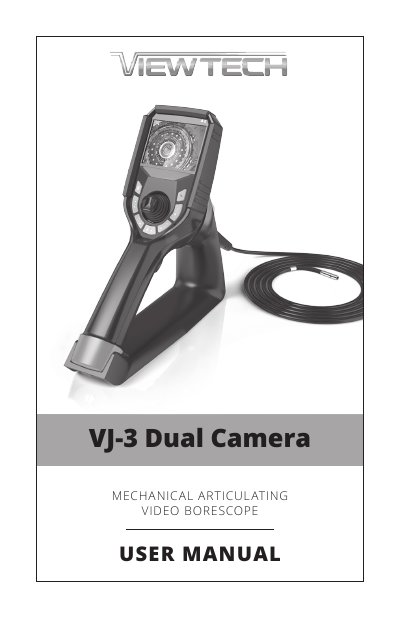
The ViewTech VJ-3 is a mechanical articulating video borescope, described in the manual as a nondestructive visual testing instrument with integrated optics, illumination, image processing and joystick-actuated steering, used for remote visual inspection of machinery, equipment and components. It consists of two modules in one system: an insertion tube with a distally mounted camera/LED module, and a base unit with control panel, LCD monitor, power source and circuitry. The factory offers it in configurations with optional insertion tube lengths and diameters and with white, infrared or ultraviolet light.
The manual covers user notices and battery safety, product specifications, the packing list, part names and functions, preparation of the case and power supply, menu operation and functions including HDMI output, basic operation such as turning on/off, inserting the insertion tube, recording and playback, storage and maintenance, and troubleshooting. A product warranty section and external specification are also included.
| Insertion Tube Outer Diameter | 6.0 mm |
|---|---|
| Insertion Tube Length | 1.5 m, 3.0 m, 5.0 m, 8.0 m |
| Exterior Material | Tungsten EasyGlide, crush-resistant |
| Articulation Range | 360° around, 160±10° backward |
| Field of View | 100° x 75° |
| Depth of Field | 7.0 mm - 80.0 mm |
| Illumination | 6 super high-intensity white LEDs |
| Display Monitor | 3.5'' IPS anti-glare LCD, 640 x 480 |
| Internal Storage | 16 GB SD card (about 10,000 photos, 8 hours video) |
| Battery | One 18650 Li-ion battery |
| Weight | 2.2 lbs. / 1.0 kg |
| Protection Grade | IP67 |
| Operating Temperature, Insertion Tube | -4 – 140°F (-20 – 60°C) |
It uses 3.6V lithium 18650B batteries with PCB protection (button top); one battery plus a spare is included in the packing list.
If the lens is dirty or greasy, it may be cleaned by wiping with alcohol.
Center the joystick to straighten the bending section first; the borescope should always be stored with the bending section straight.
The insertion tube operates from -4 to 140°F (-20 to 60°C), while the base unit range is 14 to 122°F (-10 to 50°C).