
This Thomson guide explains how to choose the right ball screw assembly based on load, speed, accuracy and installation parameters.
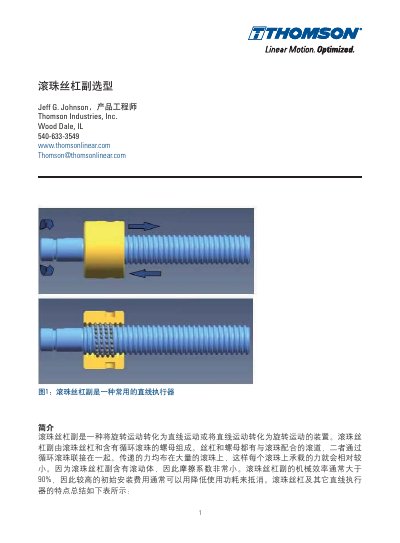
The document provides an overview of ball screw technology, describing how rotational motion is converted to linear motion and highlighting the high efficiency and low friction of ball screw assemblies. It outlines the different types of linear actuators and the key technical parameters that affect performance, such as rated static and dynamic loads, lead error and backlash.
A step‑by‑step selection process is presented, covering system basic parameters, optional input parameters, ball‑screw types, and application‑specific considerations like load direction, installation orientation and environmental factors. An example for a three‑axis welding machine demonstrates calculations for load, torque, critical speed and life expectancy, and introduces Thomson’s online selection tool for quick part identification. This manual is written in Chinese.
| Rated static load | Maximum non‑operating load capacity |
|---|---|
| Lead error | Positioning error per foot (imperial) or per 300 mm (metric) |
| Example applied load | 2,668.9 N (600 lb) |
Critical speed is calculated with the formula nc = Cs × 1.2 × 10⁸ × dr / I², where Cs is the end‑support coefficient, dr is the root diameter and I is the span.
Pre‑load makes the nut’s thread lead slightly smaller than the screw’s lead, providing higher repeatability and stiffness for precision applications.