
The onsemi NCP367 protects battery charge paths up to 30 V with overvoltage, overcurrent, and thermal shutdown protection for USB and wall adapters.
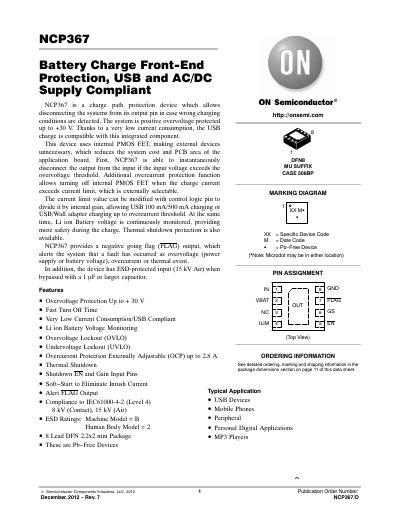
The onsemi NCP367 is a charge path protection device for battery charging applications. It disconnects the system from its output pin when wrong charging conditions are detected and is compatible with USB and wall adapter charging.
The device provides overvoltage protection up to +30 V, externally adjustable overcurrent protection up to 2.8 A, Li-ion battery voltage monitoring, and thermal shutdown. It uses an internal PMOS FET, requires no external devices, and includes a FLAG output to indicate overvoltage, overcurrent, or thermal faults.
| Input Voltage Range | 1.2 to 28 V |
|---|---|
| Overvoltage Protection | Up to +30 V |
| Overcurrent Protection | Externally adjustable up to 2.8 A |
| Operating Ambient Temperature | −40 to +85 °C |
| Package | 8 Lead DFN 2.2x2 mm |
| ESD Protection | IEC61000-4-2 Level 4, 8 kV contact / 15 kV air |
The maximum input voltage is 30 V.
It is set externally using the ILIM pin and can be divided by the GS pin gain.
It indicates overvoltage, overcurrent, or thermal shutdown events.
It is supplied in an 8 Lead DFN 2.2x2 mm package.