
Datasheet for nVent RAYCHEM HSQ mineral insulated stainless steel heating cables for hazardous-area heat tracing, with specifications and order references.
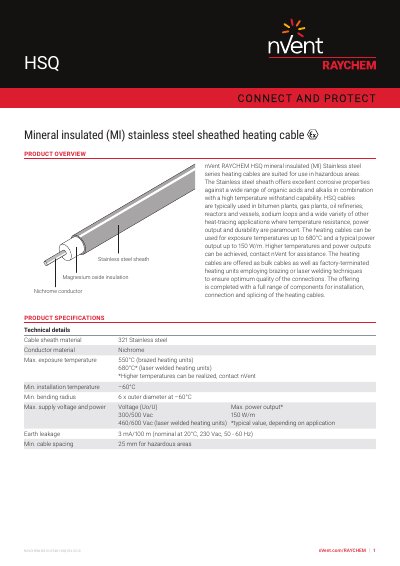
This datasheet describes the nVent RAYCHEM HSQ mineral insulated (MI) stainless steel sheathed heating cable series for hazardous-area heat-tracing applications such as bitumen plants, gas plants, oil refineries, reactors, vessels, and sodium loops. It covers construction, electrical and thermal specifications, order references, cold lead options, chemical resistance, approvals, and ordering information.
The cable is supplied as bulk cable or as factory-terminated heating units using brazing or laser welding, with components for installation, connection, and splicing. The document also lists recommended cold leads, RCD requirements, and temperature classifications for hazardous-area use.
| Cable sheath material | 321 Stainless steel |
|---|---|
| Conductor material | Nichrome |
| Max. exposure temperature, brazed heating units | 550°C |
| Max. exposure temperature, laser welded heating units | 680°C |
| Min. installation temperature | –60°C |
| Min. bending radius | 6 x outer diameter at –60°C |
| Max. supply voltage and power | 300/500 Vac; 460/600 Vac (laser welded heating units) |
| Max. power output | 150 W/m (typical value, depending on application) |
| Earth leakage | 3 mA/100 m (nominal at 20°C, 230 Vac, 50–60 Hz) |
| Min. cable spacing in hazardous areas | 25 mm |
| Temperature classification | T6 ... T1 |
| Hazardous area approvals | Zone 1 and Zone 2 (Gas), Zone 21 and Zone 22 (Dust) |
| Cold lead gland size | M25 |
| Factory terminated element max. weight | 50 kg |
The maximum exposure temperature is 550°C for brazed heating units and 680°C for laser welded heating units. Higher temperatures can be realized by contacting nVent.
The typical maximum power output is 150 W/m, depending on the application. Higher power outputs can be achieved with assistance from nVent.
It is offered as bulk cable and as factory-terminated heating units using brazing or laser welding techniques. Installation, connection, and splicing components are also available.
nVent requires a 30 mA residual current device for maximum safety and protection from fire. For adjustable devices, the preferred trip level is 30 mA above inherent capacitive leakage, with a maximum of 300 mA for non-adjustable devices.