
This manual covers the installation, adjustment, and troubleshooting of the Kunlun Hai'an JWY forked level switch for detecting solid and liquid levels.
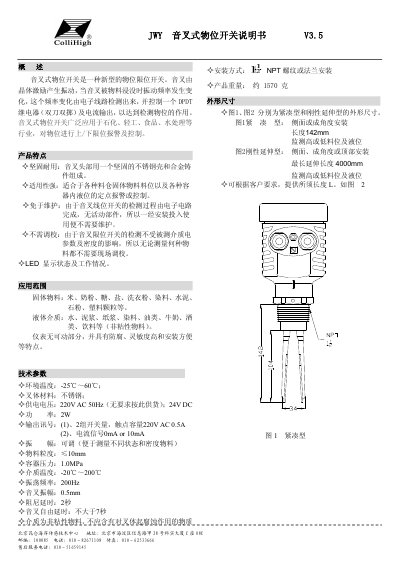
The Kunlun Hai'an JWY is a forked level switch that detects the level of solid materials or liquids by monitoring changes in the vibration frequency of a crystal-excited fork. It is designed for applications in industries such as petrochemical, light industry, food, and water treatment, providing upper and lower limit alarms and control functions. Key features include durability, versatility for various materials, maintenance-free operation, and no need for calibration. This manual is written in Chinese.
| Operating Temperature | -25℃~60℃ |
|---|---|
| Fork Material | Stainless Steel |
| Supply Voltage | 220V AC 50Hz or 24V DC |
| Output Signal | 2 sets of switch quantities or current signal 0mA or 10mA |
| Material Particle Size | ≤ 10mm |
| Container Pressure | 1.0MPa |
| Medium Temperature | -20℃~200℃ |
| Oscillation Frequency | 200 Hz |
| Fork Amplitude | 0.5mm |
| Damping Delay | 2 seconds |
| Free Delay | Not more than 7 seconds |
| Product Weight | Approx. 1570 g |
It is suitable for solid materials like rice, milk powder, sugar, salt, and cement, as well as liquid media like water, mud, paper pulp, oil, milk, and alcohol.
No, the detection is not affected by the electrical parameters or density of the measured medium, so no on-site calibration is needed regardless of the material.
Open the back cover and adjust the potentiometer W; turning counter-clockwise increases amplitude for denser materials, while clockwise decreases it for less dense materials.
Possible causes include empty material, light material, container wall vibration at 200Hz, excessive amplitude, no power, low voltage, heavy deposits on the fork, fork damage, or insufficient amplitude.