
Instruction manual for the Icom IC-M605/IC-M605EURO VHF marine transceiver, covering DSC distress and general calls, installation, precautions and emergency…
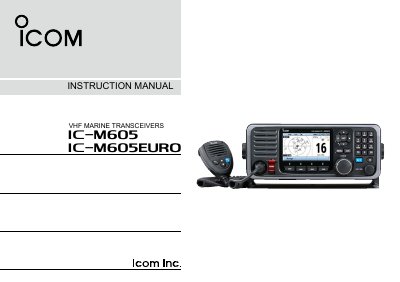
This is the instruction manual for the Icom IC-M605/IC-M605EURO VHF marine transceiver. It contains operating instructions for the transceiver, including its Digital Selective Calling (DSC) functions for distress alert transmission and reception as well as general DSC calls such as Individual, All Ships and Group calls.
The manual also covers emergency procedures on Channel 16 and Channel 70, installation and RF exposure notes, FCC information, precautions, cleaning and care guidance (such as rinsing the front panel after saltwater exposure), and definitions of the warning labels used throughout the document.
| Maximum RF power | 25 W |
|---|---|
| Front panel waterproof protection | IPX8 |
| Optional commandmic waterproof protection | IPX7 (HM-195/HM-229) |
| Operating temperature range | –20°C to +60°C (–4°F to +140°F) |
| Maximum power source voltage | 16 V DC |
Lift the key cover, hold down [DISTRESS] for 3 seconds until you hear 3 short beeps and one long beep, wait for an acknowledgment from a coast station, then hold down [PTT] and transmit the distress information.
Clean the front panel thoroughly in a bowl of fresh water and dry it before operating, otherwise salt crystallization may make the keys, switches and controllers unusable.
The antenna should be installed as high as possible, at least 1.76 meters above any accessible position, and an antenna with a maximum gain of 3 dB is recommended for the EC installation.
Keep the transceiver and microphone at least 1 meter away from the vessel's magnetic navigation compass.