
This guide explains the principles, primer design, reaction setup, and detection methods for Haigene's loop-mediated isothermal amplification (LAMP) assays.
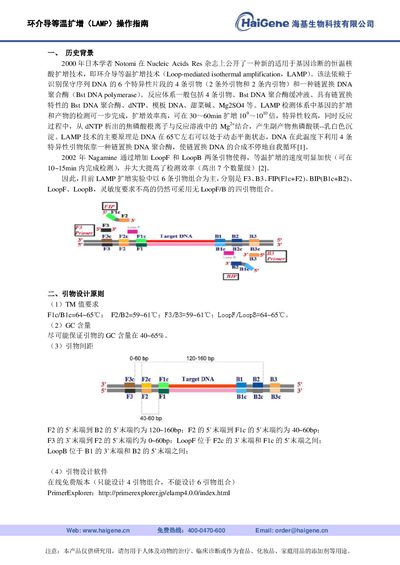
The document provides a historical background of the LAMP technique, describing its development by Notomi and subsequent improvements by Nagamine. It outlines the principle of using six specific primers and a strand‑displacing DNA polymerase to achieve rapid, high‑efficiency nucleic acid amplification at a constant temperature.
Practical sections detail primer design rules, recommended reaction components, and step‑by‑step protocols for both DNA‑LAMP and RNA‑RT‑LAMP using Haigene's Bst polymerases. Various detection methods, including visual precipitation, SYBR Green I fluorescence, and colorimetric dyes, are also described. This manual is written in Chinese.
| Bst 2.0 DNA Polymerase activity | 10 U/µl |
|---|---|
| MgSO4 concentration in reaction mix | 100 mM |
| DNA LAMP reaction temperature | 65 °C |
| RNA RT‑LAMP polymerase options | Bst 3.0 or Bst 4.0 DNA/RNA polymerase |
F1c/B1c should be 64–65 °C, F2/B2 59–61 °C, F3/B3 59–61 °C, and LoopF/LoopB 64–65 °C.
By observing the white precipitate of magnesium pyrophosphate formed during the reaction.