
This manual covers the operation, menu settings, remote control usage, and technical specifications of the Gustard DAC-X20 HD D/A Converter.
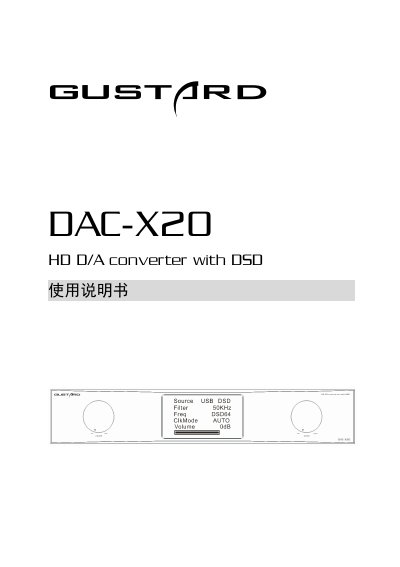
This document serves as the user manual for the Gustard DAC-X20 HD D/A Converter with DSD support. It details the front and rear panel interfaces, including the TFT display and multi-function knob operations. The guide explains how to navigate the menu system to adjust input channels, digital filters, clock modes, screen brightness, output phase, and analog gain. It also provides instructions for using the infrared remote control and installing the necessary USB drivers for Windows, Mac, and Linux systems. This manual is written in Chinese.
| THD+N | <0.0005% |
|---|
The system volume of the XMOS USB AUDIO device is not set to 100%, which destroys the DSD identification code.
These inputs support PCM at 16-24bit/44.1-192kHz and DSD DOP64.
These inputs support PCM at 16-32bit/44.1-384kHz and DSD DOP64/DOP128, including DSD512 native for USB.
The frequency response is 20-20kHz with a tolerance of -0.1dB.