
Operating and safety instructions for the GPS pM3.2 muon spectroscopy instrument.
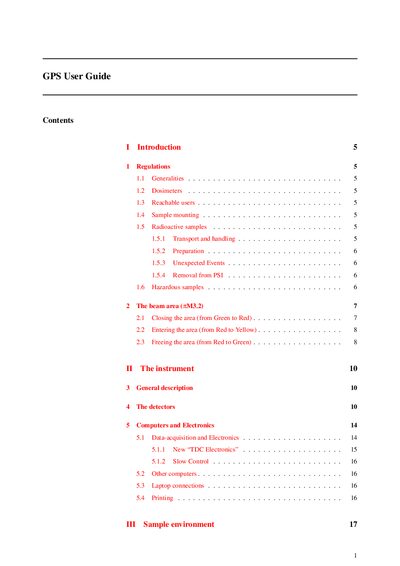
This guide provides detailed procedures for safely operating the GPS pM3.2 muon spectroscopy instrument at the Paul Scherrer Institute. It covers regulations, beam‑area access control, instrument components, sample environment, magnetic field settings, and troubleshooting.
The document includes step‑by‑step instructions for closing, entering, and freeing the beam area, as well as quick‑reference information for the MOGLI vacuum system and magnet power supplies.
| Muon detector thickness | 0.18 mm |
|---|---|
| Typical muon range in polyethylene | 1.5 mm |
| Typical muon range in aluminum | 0.65 mm |
| Magnet power supply QTH31 current | 120 A |
| Magnet power supply QTH31 voltage limit | 50 V |
Every user must carry a dosimeter provided by the dosimetry office during working hours.
Connect the 380 V power, ensure compressed‑air and vacuum lines are attached, verify the FPS display shows PST OFF and HV LOCKED, then press PST ON (F1) to start MOGLI.
QTH31 is rated for a maximum current of 120 A and a voltage limit of 50 V.