
Gefran position transducers detect linear and angular motion with technologies like potentiometric, magnetostriective, Hall effect, and MEMS for industrial…
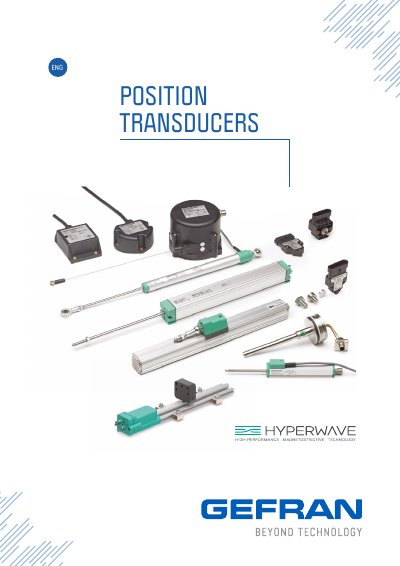
Gefran position transducers detect mechanical position in real time, helping reduce machine cycle times and enable precise actuation. Technologies include potentiometric, magnetostriective, Hall effect, and MEMS, each with unique advantages like no contact wear or high resolution. Applications span automotive, plastics, hydraulics, renewable energy, and more. Transducers are built with robust materials like stainless steel or PBT plastic for harsh environments. Models include WPG-A, WPP-A, MK4-C, and others, with outputs ranging from analog voltage to digital SSI or IO-Link formats.
| Lifespan | From 100 million manoeuvres to practically unlimited |
|---|---|
| Position Resolution | Up to 0.5μm |
| Output Formats | Analog (0...20mA, 4…20mA, 0.5…4.5Vdc, 0…5Vdc, 0…10Vdc) and Digital (SSI, IO-Link, CANopen, SAE J1939) |
These devices detect the position of mechanical parts in motion to reduce machine cycle times and intercept points for actuating other servomechanisms.
The body is constructed from anodised aluminium, AISI 316 stainless steel, or PBT plastic to resist UV rays, saline mist, acids, and other aggressive agents.
The sensor sends a 3Ampere current pulse for 3 microseconds, and the resulting torsional mechanical wave travels at approximately 2850 metres/second to calculate the magnet's position.