
User manual for Festo NPT series mechanically actuated valves, including stem and roller lever designs for pneumatic signal applications.
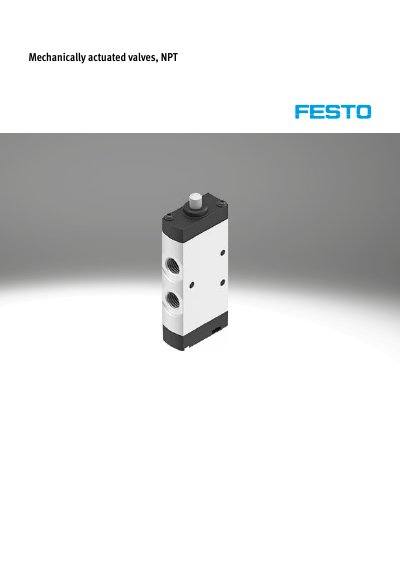
The Festo NPT series consists of mechanically actuated valves used as signal valves to return pneumatic signals to controllers, such as indicating an end position has been reached. These valves are designed for use in smaller machines and conveyor systems to control clamping and locking processes in semi-automatic assembly.
Available in stem actuated, roller lever, and roller lever with idle return designs, the series offers 3/2-way and 5/2-way functions. They feature a compact design, lightweight construction, and are available with either direct or piloted actuation.
| Flow rate | 750 ... 1200 l/min |
|---|---|
| Pressure range | -0.95 ... 10 bar |
| Temperature range | -10 ... +60°C |
| Housing Material | Anodised wrought aluminium alloy |
The valves are available as stem actuated valves, roller lever valves, and roller lever valves with idle return.
They are often used as signal valves to return a pneumatic signal to the controller, such as an end position reached signal.
The available pressure range is from vacuum to 10 bar.
They are mounted via through-holes, and stem actuated valves are also suitable for front panel mounting.