
Technical reference manual for the Digilent Analog Discovery rev. C multi-function instrument, covering its architecture, scope input divider, and hardware…
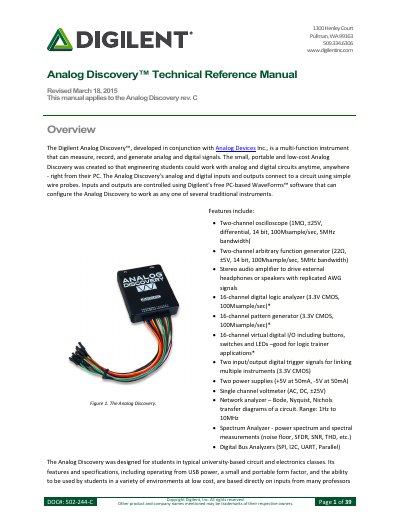
The Digilent Analog Discovery rev. C is a multi-function instrument developed with Analog Devices Inc. that can measure, record, and generate analog and digital signals. It is controlled from a PC using Digilent's free WaveForms software, which can configure it to work as several traditional instruments. The core of the hardware is a Xilinx Spartan-6 XC6SLX16-1L FPGA.
This technical reference manual describes the device's electrical functions and operations and the hardware's features and limitations. It states that it is not intended to provide enough information to duplicate the Analog Discovery or to let users design custom configurations for programmable parts. The document also covers the fully differential scope inputs, input divider and gain selection, and grounding considerations.
| Scope channels | Two-channel |
|---|---|
| Scope input impedance | 1 MΩ || 24 pF |
| AWG output impedance | 22 Ω |
| Digital logic analyzer | 16 channels, 3.3 V CMOS, 100 Msample/sec |
| Power supplies | +5 V at 50 mA; −5 V at 50 mA |
| Network analyzer range | 1 Hz to 10 MHz |
It is controlled by Digilent's free PC-based WaveForms software, which can configure it to work as several traditional instruments.
The core is a Xilinx Spartan-6 FPGA, specifically the XC6SLX16-1L device.
The FPGA communicates with the PC-based WaveForms software through a USB 2.0 connection.
Yes; the Analog Discovery scope inputs are fully differential, and a GND connection to the circuit under test is needed for a stable common mode voltage.