
Package insert for Cefoperazone Sodium for Injection 0.5-3.0 g: indications, dosage and administration, adverse reactions, contraindications and warnings.
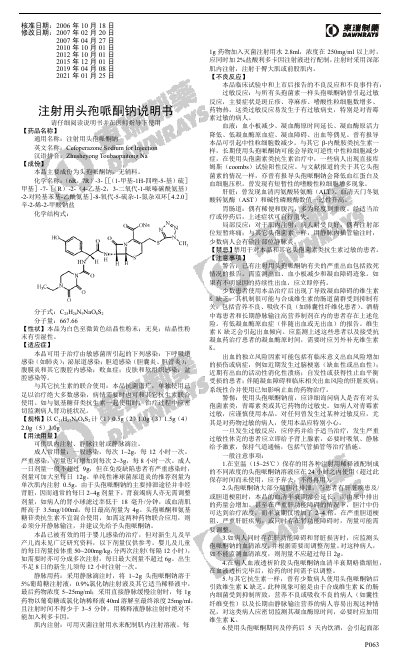
This is the Chinese package insert (说明书) for Cefoperazone Sodium for Injection (注射用头孢哌酮钠), a white to slightly yellow crystalline powder whose only ingredient is cefoperazone sodium, with no excipients. It gives the approved strengths of 0.5 g, 1.0 g, 1.5 g, 2.0 g and 3.0 g and states the chemical name, molecular formula C25H26N9NaO8S2 and molecular weight 667.66.
The insert sets out the indications (lower respiratory tract, urinary tract and biliary tract infections, peritonitis and other intra-abdominal infections, septicemia, skin and soft tissue infections and pelvic infections), the dosage for adults, infants and children, and how the powder is diluted for intravenous infusion, slow intravenous injection or intramuscular injection. It also lists reported adverse reactions and contraindications in patients allergic to cephalosporins, and gives warnings on serious bleeding, vitamin K deficiency and monitoring of prothrombin time. This manual is written in Chinese.
| Generic name | 注射用头孢哌酮钠 (Cefoperazone Sodium for Injection) |
|---|---|
| Ingredient | Cefoperazone sodium, no excipients |
| Molecular formula | C25H26N9NaO8S2 |
| Molecular weight | 667.66 |
| Appearance | White to slightly yellow crystalline powder; odorless; hygroscopic |
| Strengths | 0.5 g, 1.0 g, 1.5 g, 2.0 g, 3.0 g |
| Routes of administration | Intramuscular injection, intravenous injection or intravenous infusion |
It is used for infections caused by sensitive bacteria, including lower respiratory tract infections such as pneumonia, urinary tract infections, biliary tract infections, peritonitis and other intra-abdominal infections, septicemia, skin and soft tissue infections and pelvic infections.
For general infections, 1–2 g every 12 hours; for severe infections the dose may be raised to 2–3 g every 8 hours, with a usual daily maximum of 9 g for adults.
It can be given by intramuscular injection, intravenous injection or intravenous infusion.
At the usual daily doses of 2–4 g no adjustment is needed because the main route of excretion is not renal; if glomerular filtration rate is below 18 mL/min or serum creatinine above 3.5 mg/100 mL, the maximum daily dose is 4 g.