
Circuit design guide for the ADuCRF101 wireless data acquisition system, featuring a low-power microcontroller with an integrated RF transceiver for…
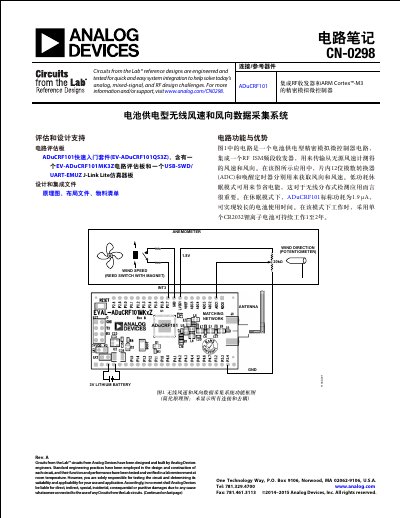
This document provides circuit design and evaluation information for the ADuCRF101, a battery-powered wireless data acquisition system. It integrates a 12-bit ADC, a Cortex-M3 microcontroller, and an RF ISM band transceiver to measure wind speed via reed switches and wind direction via potentiometers.
The guide details the use of the EV-ADuCRF101MK3Z evaluation board optimized for the 433 MHz frequency. It describes the system's operation in low-power hibernate modes, where the device wakes up only when necessary to transmit data, allowing a CR2032 lithium battery to last approximately one year under specific test conditions.
The device has a nominal power consumption of 1.9 µA when operating in sleep mode.
Using a single CR2032 lithium battery allows for operation of approximately 1 to 2 years.
The transmitter is set up to transmit data at a maximum speed of 300 kbps.