
High-speed, rail-to-rail output triple op amp with 410 MHz bandwidth and 870 V/µs slew rate for professional video, imaging, and instrumentation applications.
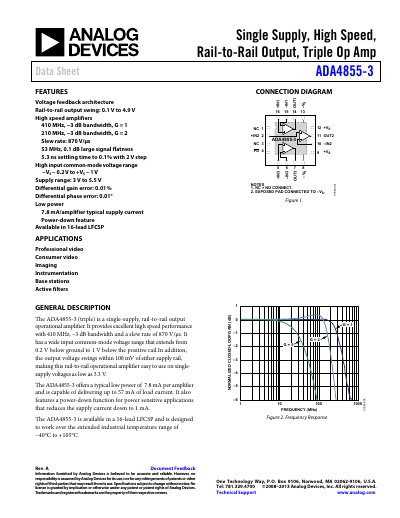
The ADA4855-3 is a single-supply, rail-to-rail output triple operational amplifier designed for high-speed applications. It features 410 MHz bandwidth and 870 V/µs slew rate, with low power consumption of 7.8 mA per amplifier. It operates over a wide input common-mode voltage range and is available in a 16-lead LFCSP package for extended industrial temperature ranges.
The datasheet includes specifications for 5V and 3.3V operation, performance characteristics, test circuits, and application information for professional video, imaging, and instrumentation systems.
| −3 dB Bandwidth (5V, G=1) | 410 MHz |
|---|---|
| Slew Rate | 870 V/µs |
| Supply Range | 3 V to 5.5 V |
| Input Common-Mode Voltage Range | −VS − 0.2 V to +VS − 1 V |
| Output Voltage Swing | 0.1 V to 4.9 V |
| Quiescent Current (5V) | 7.8 mA per amplifier |
| Power-Down Supply Current | 1.1 mA |
| Operating Temperature Range | −40°C to +105°C |
410 MHz.
870 V/µs.
7.8 mA.
−40°C to +105°C.