
The Analog Devices AD8155 is an asynchronous, protocol-agnostic dual-lane 2:1 switch supporting NRZ data rates up to 6.5 Gbps per lane.
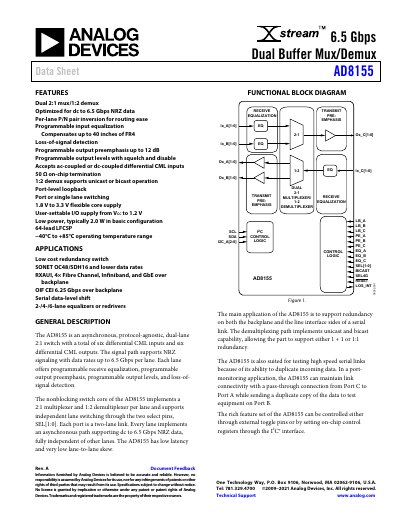
The AD8155 is a dual-lane 2:1 multiplexer and 1:2 demultiplexer featuring six differential CML inputs and six differential CML outputs. It is designed for asynchronous, protocol-agnostic signal paths supporting NRZ signaling with data rates up to 6.5 Gbps per lane, offering low latency and very low lane-to-lane skew.
Each lane includes programmable receive equalization, programmable output preemphasis, programmable output levels, and loss-of-signal detection. The device can be controlled via external toggle pins or an I2C interface and is suitable for redundancy switching, backplane applications, and high-speed serial link testing.
| Data Rate per Channel | DC to 6.5 Gbps |
|---|---|
| Operating Temperature Range | -40°C to +85°C |
| Core Supply Voltage | 1.8 V to 3.3 V |
| Propagation Delay | 700 ps |
| Typical Power Consumption | 2.0 W |
It is used for low cost redundancy switches, SONET OC48/SDH16, RXAUI, 4x Fibre Channel, Infiniband, and GbE over backplane.
The device can be controlled through external toggle pins or by setting on-chip control registers via the I2C interface.