
Datasheet for the Analog Devices AD6645, a high-speed 14-bit ADC with integrated T/H and reference, supporting up to 105 MSPS.
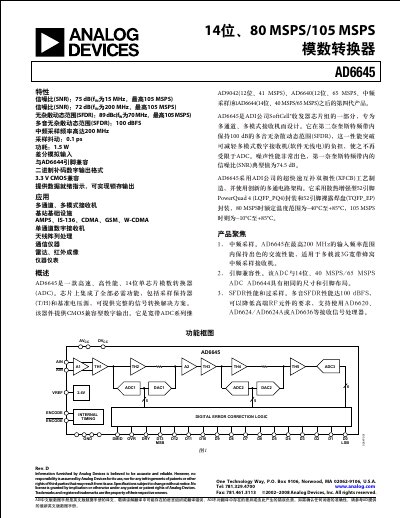
The AD6645 is a high-speed, high-performance 14-bit single-chip analog-to-digital converter (ADC) that integrates all essential functions, including a sample-and-hold (T/H) and a reference voltage source. It provides CMOS-compatible digital output and is designed for multi-channel, multi-mode receivers such as base station infrastructure, communication instruments, radar, and infrared imaging applications.
The device features a high signal-to-noise ratio (SNR) and spurious-free dynamic range (SFDR), with low sampling jitter and low power consumption. It operates at sampling rates up to 105 MSPS with a temperature range of -10°C to +85°C, and is available in 52-lead PowerQuad 4 and 52-lead TQFP_EP packages. This manual is written in Chinese.
| SNR | 75 dB (15 MHz) |
|---|---|
| SFDR | 89 dBc (70 MHz) |
| Max Sampling Rate | 105 MSPS |
| Power Consumption | 1.5 W |
| Supply Voltage AVCC | 5.0 V |
The AD6645 supports sampling rates up to 105 MSPS.
Yes, the chip integrates all essential functions, including a sample-and-hold (T/H) and a reference voltage source.
The typical SNR is 75 dB at an input frequency of 15 MHz.