
The Agilent E8267C PSG Data Sheet provides specifications, performance characteristics, and interface details for the vector signal generator.
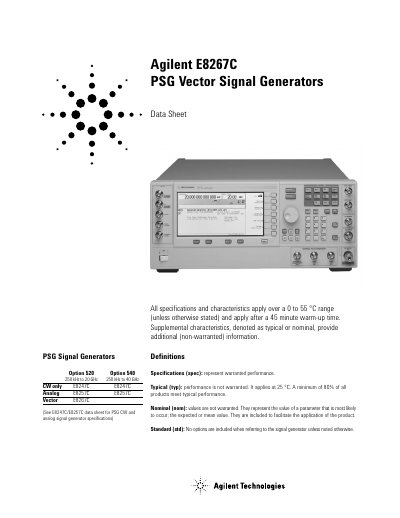
This data sheet describes the Agilent E8267C PSG vector signal generator, covering its frequency coverage, output power, modulation options, and electrical interfaces. It lists the operating temperature range, warm‑up time, and the meaning of specification symbols such as Spec, Typical, and Nominal.
Key sections include frequency range (250 kHz‑20 GHz), output power limits, sweep modes, modulation capabilities (FM, PM, AM, pulse, vector, I/Q baseband), connector types, optional accessories, and remote programming interfaces. The document also provides detailed performance tables for phase noise, spectral purity, and harmonic levels.
| Frequency range | 250 kHz to 20 GHz |
|---|---|
| Maximum CW output power | +13 dBm (250 kHz‑3.2 GHz) |
| Input impedance | 50 Ω (nominal) |
| Output impedance | 50 Ω (nominal) |
| Maximum sweep rate | 400 MHz/ms (20 GHz span) |
| Phase‑noise (Option UNR) at 10 GHz | –68 dBc/Hz (typical) |
The generator covers 250 kHz to 20 GHz (Option 520).
It can deliver up to +13 dBm in CW mode from 250 kHz to 3.2 GHz.