
The Affymetrix GeneChip E. coli Genome 2.0 Array datasheet describes probe set coverage, technical specifications and ordering information for the microarray.
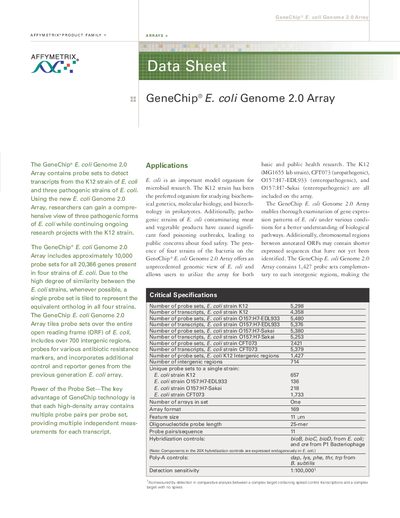
The GeneChip® E. coli Genome 2.0 Array provides probe sets for the K12 strain and three pathogenic E. coli strains, covering all 20,366 genes and over 700 intergenic regions. Approximately 10,000 probe sets are tiled across the entire open reading frames, with multiple probe pairs per set for reliable measurement.
The datasheet lists key technical parameters such as 11 µm feature size, 25‑mer oligonucleotide probes, 11 probe pairs per sequence, and detection sensitivity of 1:100,000. It also includes ordering details, required instrumentation (GeneChip Scanner 3000) and software (GCOS v1.1.1 or later), and hybridization control sequences.
| Feature size | 11 µm |
|---|---|
| Oligonucleotide probe length | 25‑mer |
| Probe pairs per sequence | 11 |
| Hybridization controls | bioB, bioC, bioD (E. coli) and cre (P1 bacteriophage) |
| Detection sensitivity | 1:100,000 |
| Required scanner | GeneChip® Scanner 3000 (High‑Resolution) |
| Required software | GeneChip® Operating Software (GCOS) v1.1.1 or later |
The array has a feature size of 11 µm.
Data analysis requires the GeneChip® Scanner 3000 for high‑resolution scanning and GeneChip® Operating Software (GCOS) version 1.1.1 or later.