
This document is an introduction to the CALOMAT 6 thermal conductivity gas analyzer and its features. The analyzer is primarily used for quantitative analysis of hydrogen or helium in binary or quasi-binary gas mixtures, and can also be used to determine the concentration of other gases in the sample. The analyzer features a semiconductor detector, short response time, high dynamic measurement range, and integrated interference gas correction.
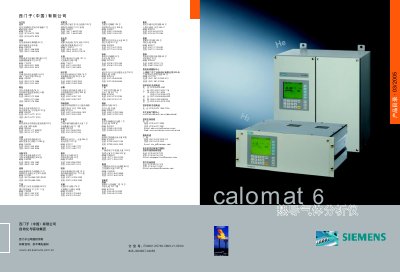
The Siemens CALOMAT 6 is a thermal conductivity gas analyzer used mainly for quantitative analysis of hydrogen or helium in binary or quasi-binary gas mixtures. It can also determine concentrations of gases such as argon, carbon dioxide, methane or ammonia when their thermal conductivity differs significantly from the residual gas.
The document describes the analyzer's features, applications, design, function, integration, rack-mounted and field-mounted versions, technical and ordering data, dimensions, electrical connections, explosion-proof design, BARTEC EEx p control unit, Ex purge unit MiniPurge FM, documents and spare parts. This manual is written in Chinese.
| Measurement principle | Thermal conductivity of gases |
|---|---|
| Detector | Semiconductor detector |
| Response time | Very short T90 |
| Measuring ranges | Four freely configurable ranges, linear, with zero shift |
| Minimum measuring range for H2 | 0...1% (95...100% with forced zero) |
| Analog output | Electrically isolated 0/2/4...20 mA |
| Digital display | 5-digit measurement value |
| Communication (standard) | RS485 |
| Gas path material | Stainless steel type 1.4571 |
| Leak rate | <1 µl/s |
| O-ring material | FFKM - Chemraz |
| Sensor materials | Si, SiOxNy, AU, epoxy resin, glass |
It is mainly used for quantitative analysis of hydrogen or helium in binary or quasi-binary gas mixtures.
It measures based on the different thermal conductivities of gases.
RS485 is standard.
The leak rate is less than 1 µl/s.