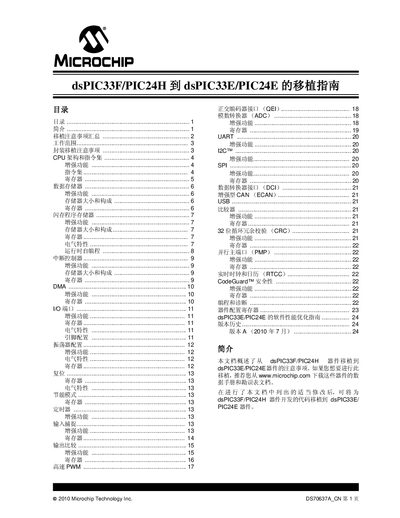
This guide explains how to port software from dsPIC33F/PIC24H devices to dsPIC33E/PIC24E microcontrollers, covering architecture, peripherals, and…
About this manual
The document provides a comprehensive overview of the differences between the older dsPIC33F/PIC24H family and the newer dsPIC33E/PIC24E family. It outlines the migration considerations, including changes in CPU architecture, instruction set, memory organization, and peripheral features.
Key sections describe the expanded flash and RAM capacities, higher maximum CPU speed, additional DMA channels, new USB OTG support, and the updated interrupt vector table. The guide also details required software changes such as peripheral pin select (PPS) remapping, extended data space (EDS) usage, and updated configuration registers. This manual is written in Chinese.
What's inside
- Introduction
- Migration Considerations Summary
- Operating Range
- CPU Architecture and Instruction Set
- Data Memory
- Flash Program Memory
- Interrupt Controller
- DMA
- Device Configuration Registers
- Software Performance Optimization Guide
Specifications
| Maximum flash program memory | 512 KB |
|---|
| Maximum data RAM | 52 KB |
|---|
| Maximum CPU speed | 60 MIPS |
|---|
| DMA channels | 15 |
|---|
| USB module | OTG support added |
|---|
Frequently asked questions
What is the maximum operating frequency of dsPIC33E/PIC24E devices?
The dsPIC33E/PIC24E family can run at up to 60 MIPS.
How many DMA channels do dsPIC33E/PIC24E devices have compared to dsPIC33F/PIC24H?
The newer devices provide 15 DMA channels, while the older dsPIC33F/PIC24H devices have 8 channels.
What flash memory size is available in dsPIC33E/PIC24E compared to dsPIC33F/PIC24H?
The dsPIC33E/PIC24E devices offer up to 512 KB of flash, double the 256 KB available in the older series.