
This document introduces the features and usage of LPC2103 and EasyARM2103.
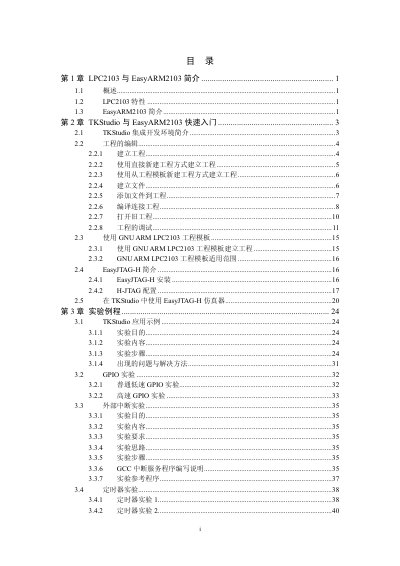
This document introduces the NXP LPC2103 microcontroller and the ZLG EasyARM2103 development board, including the board's features and available experiment examples.
It also explains the TKStudio integrated development environment, project editing, EasyJTAG-H debugger setup, and application examples for the EasyARM2103 board. This manual is written in Chinese.
| CPU | 16/32-bit ARM7TDMI-S microcontroller |
|---|---|
| Package | LQFP48 |
| SRAM | 8 KB on-chip static RAM |
| Flash | 32 KB on-chip Flash program memory |
| Maximum clock | Up to 70 MHz |
| ADC | 10-bit A/D converter with 8 analog inputs |
| GPIO | Up to 32 general-purpose I/O pins |
| External interrupts | Up to 13 edge/level-triggered external interrupt pins |
The EasyARM2103 board uses an NXP LPC2103 chip based on the ARM7TDMI-S core in an LQFP48 package.
TKStudio IDE was developed by Guangzhou Zhiyuan Electronics Co., Ltd.
The document describes using the EasyJTAG-H emulator in TKStudio.