
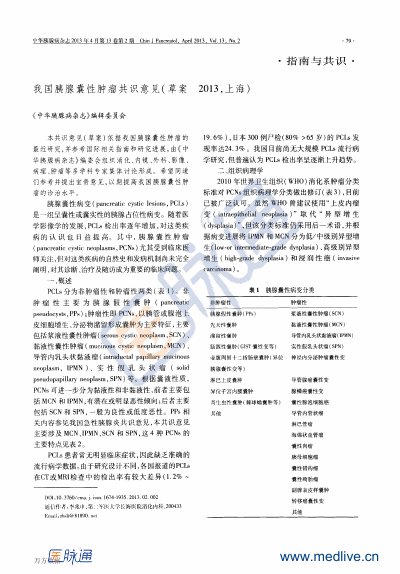
This consensus mainly involves MCN, IPMN, SCN and SPN, and the main characteristics of these four PCNs are shown in Table 2.
This document is a draft consensus opinion on pancreatic cystic neoplasms prepared by the editorial committee of the Chinese Journal of Pancreatic Diseases. It reviews classification, histopathology, clinical manifestations, and imaging of pancreatic cystic lesions.
The consensus focuses on mucinous cystic neoplasm, intraductal papillary mucinous neoplasm, serous cystic neoplasm, and solid pseudopapillary neoplasm, including their pathologic subtypes and imaging evaluation. This manual is written in Chinese.
It mainly covers mucinous cystic neoplasm, intraductal papillary mucinous neoplasm, serous cystic neoplasm, and solid pseudopapillary neoplasm.
Common studies include abdominal ultrasound, CT, MRI, EUS, ERCP, and PET.
Ovarian-type stroma beneath the epithelial cell layer is characteristic and necessary for diagnosis.
About 20% to 30% of cases are multifocal.