
The 2HSS1106H is a new type of simple stepper servo drive that perfectly integrates with servo technology. This stepper servo drive adopts the latest 32-bit DSP and integrates advanced power angle closed-loop control algorithm. Compared with traditional stepper drives, it can avoid the problem of stepper motor losing steps to the greatest extent, effectively suppress motor temperature rise, significantly reduce motor vibration, and greatly enhance motor high-speed performance. The cost of the drive is 50% of the AC servo system, and the motor size is compatible with traditional stepper motors, which is convenient for customers to replace and upgrade. In short, this stepper servo drive integrates the advantages of no丢步, low temperature rise, high speed, high torque and low cost. It is a cost-effective motion control product.
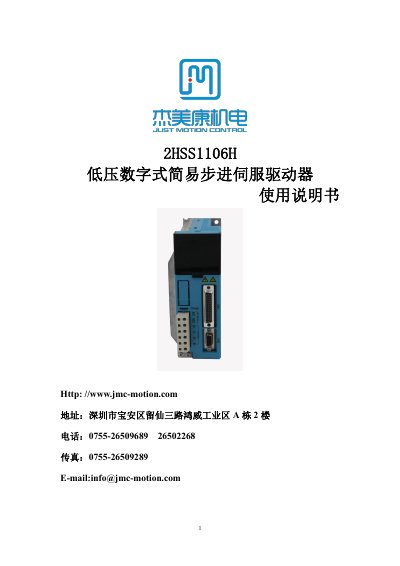
This manual describes the 2HSS1106H, a low-voltage digital simple stepper servo drive from Shenzhen JMC Electromechanical (杰美康). The drive uses a 32-bit DSP with position closed-loop control to avoid step loss, reduce motor temperature rise and vibration, and improve high-speed performance compared with conventional stepper drives.
The manual covers the product introduction, electrical and environmental specifications, fault codes, interface definitions and wiring (power terminals, control signal port, encoder and RS232), parameter settings and adjustment via the front panel, typical application wiring, and common problems such as no display at power-on, alarms, and no rotation after pulse input. This manual is written in Chinese.
| Input voltage | 50~110VAC |
|---|---|
| Continuous current output | 6.0A |
| Logic input current | 7~20mA (10mA typical) |
| Default communication rate | 57.6Kbps |
| Overcurrent trip value | 12A±10% peak |
| Overvoltage trip value | 250VDC |
| Dimensions | 157×129.5×64.3 mm |
| Weight | approx. 1500g |
| Storage temperature | -20℃~+65℃ |
| Humidity | 40~90%RH |
| Cooling method | Natural cooling or forced air |
Check the power supply line and whether the input voltage is too low.
Check the motor feedback signal line and motor power phase lines, whether the input voltage is too high or low, whether the phase sequence is correct, whether the encoder line count setting matches the motor, and whether the pulse input speed exceeds the motor's rated speed causing position error.
Check that the pulse input wiring is secure, that the input mode is set to a pulse-input-related mode, and that the motor is enabled.
Select AC50~120VAC according to the matched motor voltage rating.