
2HSS86H-A-XX Hybrid Stepper Servo Driver is a high cost performance motion control product. It has the characteristics of no loss of steps, precise positioning, 100% rated torque driving motor, variable current control technology, high current efficiency, low vibration, stable low speed operation, built-in acceleration and deceleration control, improved starting and stopping smoothness, user-defined subdivision, compatible with 1000 lines and 2500 lines encoders, general application parameters do not need to be adjusted, overcurrent protection, overvoltage protection, and over-tolerance protection.
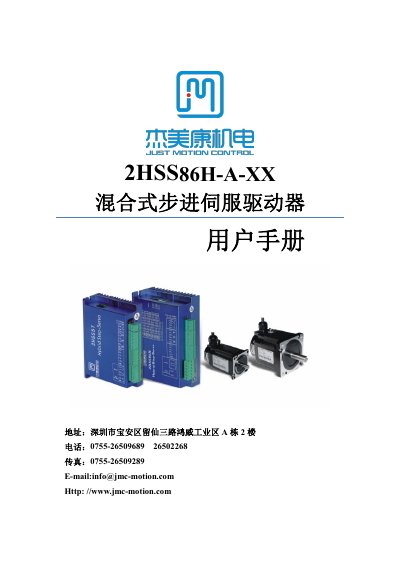
The 2HSS86H-A-XX hybrid stepper servo driver combines stepper and servo control technology, uses an optical encoder, samples position feedback every 50 microseconds, and corrects position deviation. It is described as having no lost steps, 100% rated torque drive, variable current control, low vibration, built-in acceleration and deceleration control, user-defined microsteps, and compatibility with 1000-line and 2500-line encoders.
The manual describes the ALM/PEND, control, encoder feedback, and power ports; technical specifications; single-ended common-anode, single-ended common-cathode, differential, RS-232, and timing wiring; DIP switch settings; error alarms and LED blink counts; installation dimensions; wiring diagram; parameter settings; and troubleshooting. This manual is written in Chinese.
| Input voltage | 24~70 VAC (50 V typical) or 30~100 VDC |
|---|---|
| Continuous current | 7.5 A at 20 kHz PWM |
| Maximum pulse frequency | 200K |
| Default communication rate | 57.6 Kbps |
| Overcurrent protection | 12 A ±10% peak |
| Overvoltage protection | 130 VDC |
| Dimensions | 150 × 97.5 × 53 mm |
| Weight | About 580 g |
| Operating temperature | 0~70 °C |
| Storage temperature | -20 °C to +80 °C |
| Humidity | 40~90% RH |
| Cooling | Natural cooling or forced air |
| Operating environment | Avoid dust, oil mist, and corrosive gases |
Check the input power line and whether the voltage is too low.
Check the motor feedback signal lines and motor power phase lines.
Check whether the motor phase sequence is connected correctly.
Check whether the pulse input wiring is reliable.