
The document describes the operation and maintenance manual for the TSI 8530/8531/8532 DUSTTRAKTM II Aerosol Monitor.
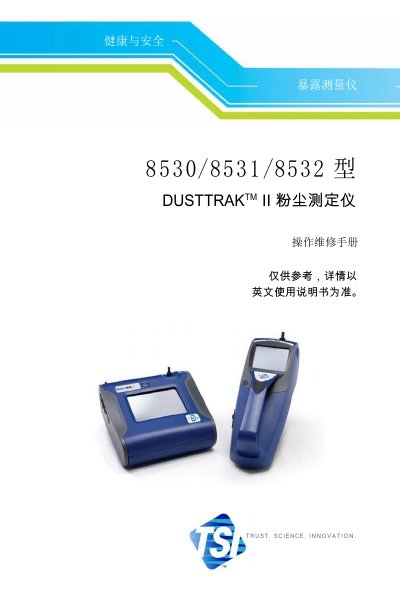
This document is the Chinese-language operation and service manual for the TSI DustTrak II aerosol monitors, models 8530 and 8531 (desktop) and 8532 (handheld). It is marked as a reference copy, with the English manual stated to take precedence. The manual covers unpacking, battery and AC adapter power setup, inlet and impactor accessories, connection to a computer with TRAKPRO data analysis software, and analog/alarm output wiring.
Operation chapters describe the setup menu, zero and flow calibration, alarms, analog output, run and measurement modes, logging modes and mass concentration readings. Further chapters cover the maintenance schedule, cleaning and filter replacement, troubleshooting, and Appendix A lists technical specifications such as the 90° light-scattering sensor, measurement ranges and flow rate. This manual is written in Chinese.
| Sensor type | 90° light scattering |
|---|---|
| Measurement range (8530 desktop) | 0.001–150 mg/m³ |
| Measurement range (8531 desktop HC) | 0.001–400 mg/m³ |
| Measurement range (8532 handheld) | 0.001–150 mg/m³ |
| Accuracy | ±0.1% of reading or ±0.001 mg/m³ |
| Particle size range | 0.1 to approx. 10 µm |
| Flow rate | 3 L/min, adjustable 1.4–3 L/min |
| Operating temperature | 0 °C to 50 °C |
| Operating humidity | 0–95% RH |
| Time constant | 1–60 seconds, adjustable |
| Data logging | 45 days at 1-minute logging; interval 1 second to 1 hour |
| Communications | 8530/8531: USB or Ethernet; 8532: USB; thumb drive data storage |
| AC power | AC adapter 115–240 VAC |
The 8530/8531/8532 dust monitors are Class I laser devices, and under normal operation you will not be exposed to laser radiation.
TSI warrants the goods against defects in workmanship and materials for two years from the shipment date under normal use and maintenance as described in the manual.
No. Users must not open the instrument or touch internal parts; service and maintenance must be performed by qualified personnel, and there are no user-serviceable parts inside.
Batteries must not be discarded as trash and should be recycled per local environmental requirements; a retired instrument should be returned to TSI for processing and recycling.