
ABI Band 2 (0.64 µm) has the finest spatial resolution (0.5 km at the sub-satellite point) of all ABI bands. Thus it is ideal to identify small-scale features such as river fogs and fog/clear air boundaries, or overshooting tops or cumulus clouds. It has also been used to document daytime snow and ice cover, diagnose low-level cloud-drift winds, assist with detection of volcanic ash and analysis of hurricanes and winter storms. The ‘Red’ Visible band is also essential for creation of “true color” imagery.
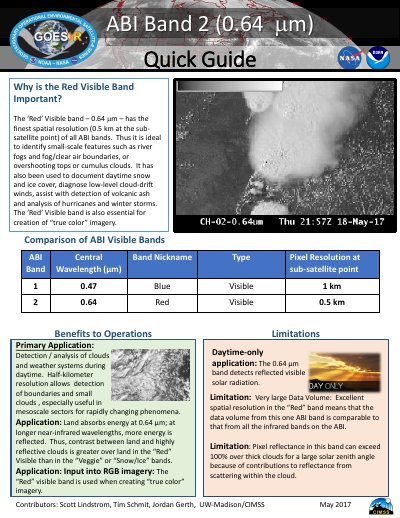
This quick guide describes ABI Band 2, the 0.64 µm "Red" Visible band, which has the finest spatial resolution of all ABI bands at 0.5 km at the sub-satellite point. Its primary application is the detection and analysis of clouds and weather systems during daytime: small-scale features such as river fogs and fog/clear air boundaries, overshooting tops and cumulus clouds, as well as daytime snow and ice cover, low-level cloud-drift winds, volcanic ash, hurricanes and winter storms. The band is also used as input into RGB imagery when creating "true color" imagery. Over land, contrast between the surface and highly reflective clouds is greater in the Red Visible band than in the "Veggie" or "Snow/Ice" bands.
The guide lists limitations: very large data volume, comparable to that from all the infrared bands on the ABI; pixel reflectance that can exceed 100% over thick clouds at a large solar zenith angle; and daytime-only use, because the band detects reflected visible solar radiation. A comparison table gives Band 1 (0.47 µm, Blue Visible, 1 km) against Band 2 (0.64 µm, Red Visible, 0.5 km), and a final page lists interpretation resources and notes that GOES-16 has on-board visible calibration so bright whites will not fade as the spacecraft ages.
| Band number | 2 |
|---|---|
| Central wavelength | 0.64 µm |
| Band nickname | Red Visible |
| Type | Visible |
| Pixel resolution at sub-satellite point | 0.5 km |
| Primary application | Detection / analysis of clouds and weather systems during daytime |
Its primary application is detection and analysis of clouds and weather systems during daytime, and it is also used as input into RGB true color imagery.
0.5 km at the sub-satellite point, the finest spatial resolution of all ABI bands.
Because the 0.64 µm band detects reflected visible solar radiation.
Land absorbs energy at 0.64 µm while more energy is reflected at longer near-infrared wavelengths, so contrast between land and highly reflective clouds is greater than in the Veggie or Snow/Ice bands.