
This document provides design guidelines for interchanges and grade separations.
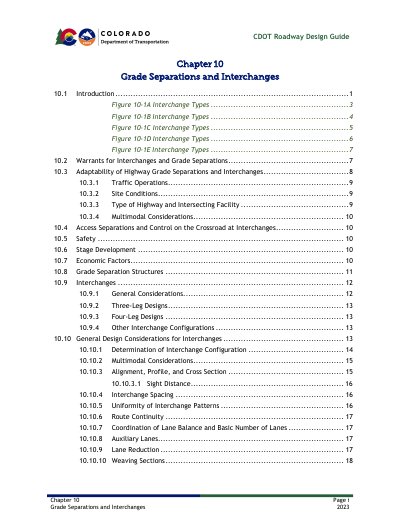
This document is Chapter 10 of the 2023 CDOT Roadway Design Guide. It addresses grade separations and interchanges, starting with an introduction and warrants for interchanges and grade separations, then adaptability, access separations and control on the crossroad, safety, stage development, economic factors, grade separation structures, and interchanges.
The chapter also covers general design considerations for interchanges, ramps, interchange design criteria, speed-change lanes, multimodal accommodations, and other interchange design features. It includes figures and tables on interchange types, weaving sections, ramp terminals, and speed-change lane lengths.
An interchange is a system of two or more interconnecting roadways or highways and one or more grade separations.
Interchange types are characterized by the basic shapes of ramps, such as diamond, loop, directional, "urban," and cloverleaf interchanges.
The design of an interchange must be considered in conjunction with adjacent interchanges, driver expectancy, and the at-grade intersections on the intersecting corridors.
Cloverleaf interchanges are not as common anymore due to more operationally efficient interchange alternatives that do not require as large of a physical footprint.