
This section introduces the design requirements for concrete structures, including general requirements, design strength, material properties, concrete classification, reinforcement classification, and concrete combination.
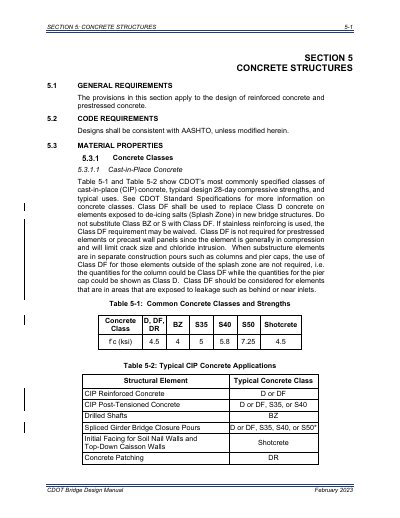
This document outlines CDOT’s design standards for concrete structures, including material classes, strength requirements, and reinforcement rules. It specifies concrete classes like DF for salt-exposed zones and defines allowable strengths for precast elements. Reinforcement details, including bar sizes, lap lengths, and cover requirements, are provided with AASHTO-based guidelines and local modifications for Colorado’s conditions.
The manual also covers prestressing strand and bar specifications, corrosion-resistant materials, and concrete insert materials to prevent corrosion. Designers must follow AASHTO unless modified, and approvals are required for special cases or materials like lightweight concrete or glass FRP rebar.
| Concrete Class DF | Used for elements exposed to de-icing salts (Splash Zone) in new bridge structures |
|---|---|
| Maximum Design Strength for Precast Girders | f’ci = 6.5 ksi, f’c = 8.5 ksi |
| Prestressing Strand Diameter | 0.60 in. diameter, low-relaxation strand |
| Prestressing Bar Strength | 150 ksi design ultimate tensile strength |
| Minimum Clear Cover for CIP Slabs Not Cast Against Earth | 1 in. minimum cover |
Class DF shall be used to replace Class D concrete on elements exposed to de-icing salts (Splash Zone) in new bridge structures.
Shop produced precast concrete girders shall be Class PS concrete and shall be limited to the following maximum design strengths: • f’ci = 6.5 ksi • f’c = 8.5 ksi
Prestressing strand shall be 0.60 in. diameter, low-relaxation strand, with a design ultimate tensile strength of 270 ksi.
For CIP slabs not cast against earth or CIP deck bottoms, 1 in. minimum cover shall be used.