
Introduces the technical features of Nextel™ ceramic textiles, including health and safety, terminology, nomenclature, fiber selection guide, weight loss, shrinkage, fibers, yarns, sewing thread, sewing instructions and fabric.
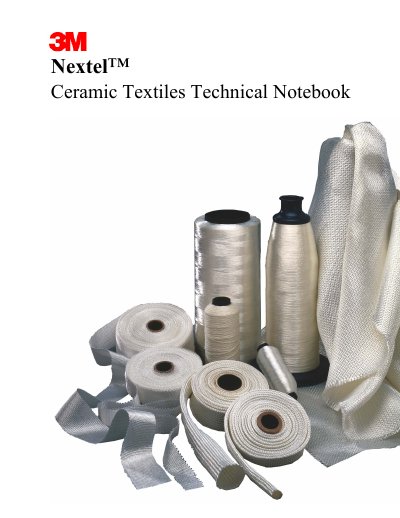
3M Nextel Ceramic Textiles Technical Notebook describes Nextel continuous filament ceramic oxide fibers and the textiles made from them, including fabrics, paper, tapes, sleevings, and yarn. It covers fiber grades 312, 440, 550, 610, and 720 and their use in industrial and composite applications.
Sections address health and safety, terminology, fiber selection, weight loss and shrinkage, sewing, thermal protection, chemical and metal compatibility, moisture absorption, electrical insulation, radiation, cryogenic and aerospace properties, thermal optical properties, and heat cleaning and heat treating instructions.
| Fiber composition | Refractory aluminoborosilicate (312 and 440), aluminosilica (550 and 720), and alumina (610) fibers |
|---|---|
| Fiber diameter | 7-13 microns |
| Fiber length | Continuous lengths |
| Respirability | Not considered respirable |
They are refractory aluminoborosilicate (312 and 440), aluminosilica (550 and 720), and alumina (610) fibers.
The fibers have diameters ranging from 7-13 microns.
They are not considered respirable because their diameters are about 7 to 13 microns.
Use exhaust ventilation providing a minimum capture velocity of 150 ft/min.