
This is a manual for a mixing console, which can be connected to microphones, lines and other input sources, and the volume and effects of the input sources can be controlled by the mixing console.
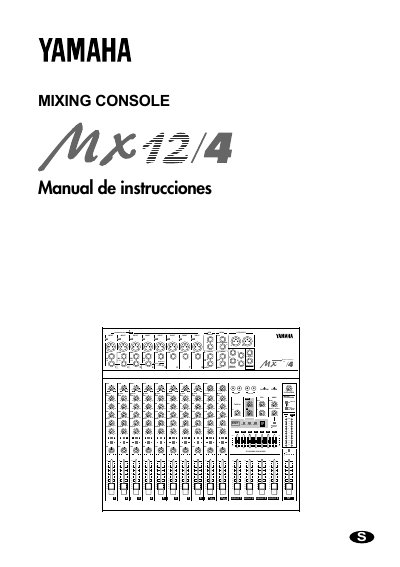
This Spanish-language user manual covers the Yamaha MX12/4 mixing console, a 12-input/4-group-output mixer with a built-in digital effects unit, phantom power, insert jacks on channels 1-4, and XLR microphone plus TRS line inputs on channels 1-8.
It describes the front-panel channel and main controls, rear-panel connections, an application example, and specifications including channel equalization, peak indication, stereo graphic equalization, and tape input/output jacks. This manual is written in Spanish.
| Inputs and group outputs | 12 inputs / 4 group outputs |
|---|---|
| Input channels | 12 input channels |
| Microphone and line inputs | Channels 1-8: XLR microphone and TRS line inputs |
| Phantom power | Phantom power for electrostatic microphones |
| Digital effects | Built-in digital effects unit |
| Insert jacks | INS I/O jacks on input channels 1-4 |
| C-R OUT | C-R OUT jack for secondary amplifier monitoring |
| MONO 1 send | MONO 1 send is pre-fader |
| EFFECT/MONO 2 send | EFFECT/MONO 2 send is post-fader |
| Channel equalization | ±15 dB at high 2 kHz, mid 2.5 kHz, low 80 Hz |
| Peak indicator | Lights red 3 dB before clipping |
| Graphic equalizer | 7-band stereo graphic equalizer |
| Graphic equalizer range | ±12 dB adjustment |
| Graphic equalizer bands | 125, 250, 500, 1, 2, 4, 8 kHz |
| Tape connections | TAPE IN and REC OUT jacks |
| ST output selector | ST or GROUP 3/4 positions |
| Group level regulators | Level regulators for groups 1-4 |
| Stereo master regulator | Stereo master level regulator (ST) |
It allows connection to a secondary amplifier for monitoring the main stereo output, TAPE IN input, and effects/monitor signals.
Each channel provides ±15 dB control at 2 kHz high, 2.5 kHz mid, and 80 Hz low.
It is a 7-band stereo graphic equalizer with ±12 dB adjustment at 125, 250, 500, 1, 2, 4, and 8 kHz.
Yes, it provides phantom power for electrostatic microphones requiring an external power source.