
This is a troubleshooting guide for the Inoue Balloon Catheter
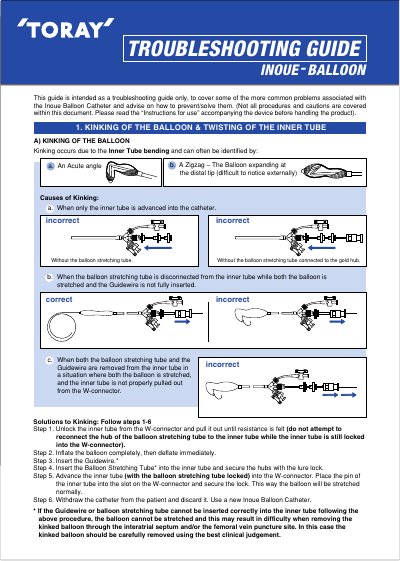
This guide addresses common issues like balloon kinking and inner tube twisting during use. It provides step-by-step solutions, including proper inflation techniques and handling of the guidewire and balloon stretching tube. It also warns against over-inflation and rapid pressure increases that may cause mesh breakage.
The document emphasizes correct manipulation techniques to prevent damage, such as holding the W-connector instead of the inner tube, and advises discarding the catheter if kinking occurs and using a new one.
Kinking occurs due to the inner tube bending, often identified by an acute angle or zigzag pattern at the distal tip when the balloon expands without the stretching tube.
Use a new Inoue Balloon Catheter.
Place the pin of the inner tube into the slot on the W-connector and secure the lock.
Mesh breakage may be caused by over-inflation or rapid pressure increase.