
This document introduces the use of the Biacore T200 surface plasmon resonance instrument, including sample preparation, data collection, data analysis, shutdown, and data management. The instrument can be used to measure dynamic binding constants and equilibrium binding constants between biomolecules.
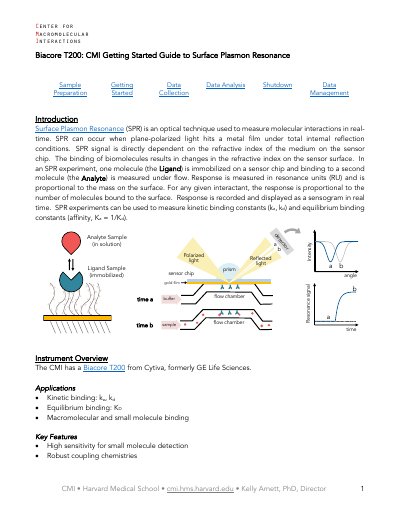
This manual provides instructions for using the Biacore T200, a surface plasmon resonance instrument from Cytiva. It covers sample preparation, data collection, and analysis for measuring kinetic and equilibrium binding constants. The guide includes details on sensor chip types, buffer requirements, and experimental design for optimal results.
The Biacore T200 supports various coupling chemistries including amine, thiol, streptavidin, NTA, and antibody capture. It features temperature control (4–45°C) and is designed for single-cycle kinetics. Users are instructed to prepare analyte samples in running buffer and to filter or centrifuge samples to avoid aggregates that can interfere with measurements or damage the sensor.
| Temperature Control | 4–45°C |
|---|---|
| Flow Cell Configuration | Four flow cells, two used per experiment |
| Recommended Flow Rate (Immobilization) | 10 µl/min |
| Recommended Flow Rate (Kinetic Assay) | 50 µl/min (minimum 30 µl/min) |
| Maximum Injection Volume | 408 µl per injection |
Maximum target density: 8000-10000 RL.
Recommended ligand concentration: 10-50 µg/ml (~25 µg/ml).
Recommended flow rate during kinetic assay is 50 µl/min (minimum 30 µl/min).
Maximum target density: 1,000-3,000 RL.