
EIB-UG01-PF2 and EIB-UG01-PL2 are Cisco's Gigabit PoE Power Supply Switches, supporting 1000BASE-T, 100BASE-TX, 10BASE-T network protocols.
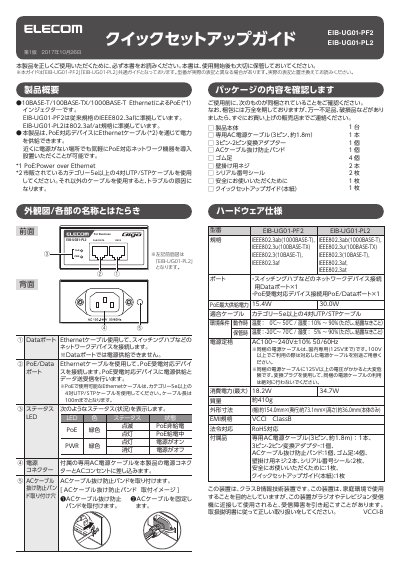
This document is a Quick Start Guide for the ELECOM EIB-UG01-PF2 and EIB-UG01-PL2 PoE injectors. It explains how to connect the device to a network and power source, detailing the function of the Data and PoE/Data ports. The guide specifies that the EIB-UG01-PF2 supports the IEEE 802.3af standard, while the EIB-UG01-PL2 supports both IEEE 802.3af and IEEE 802.3at standards. This manual is written in Japanese.
| Standards | IEEE802.3ab (1000BASE-T), IEEE802.3u (100BASE-TX), IEEE802.3 (10BASE-T) |
|---|---|
| PoE Standard (PF2) | IEEE802.3af |
| PoE Standard (PL2) | IEEE802.3af/at |
| Max PoE Power (PF2) | 15.4W |
| Cable Category | Category 5e or higher |
| Operating Temperature | 0°C to 50°C |
| Storage Temperature | -20°C to 70°C |
| Input Voltage | AC100-240V |
| Weight | Approx. 410g |
| Dimensions | 154.0mm x 73.1mm x 36.0mm |
The EIB-UG01-PF2 supports the IEEE 802.3af standard, while the EIB-UG01-PL2 supports both IEEE 802.3af and IEEE 802.3at standards.
You must use Category 5e or higher 4-pair UTP/STP cables to avoid trouble.
No, the included cable is for domestic use up to 125V. Using it with higher voltage is dangerous and must not be done.