
This manual describes the functions of the pH or redox transmitter type 8202, including functional description, technical parameters, and installation instructions.
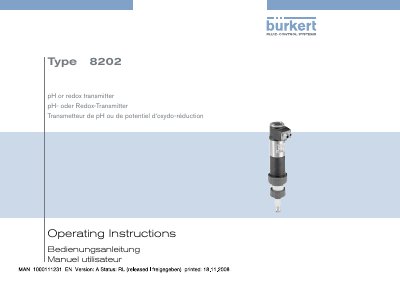
This manual provides detailed instructions for installing, operating, and maintaining the Bürkert Type 8202 pH or redox transmitter. It includes safety guidelines, electrical and mechanical specifications, sensor calibration, and troubleshooting. The device is designed for measuring pH or oxidation-reduction potential in liquids with low conductivity. It features programmable outputs for control and alarm functions. Maintenance and disposal instructions are also included.
| Component Material | Box / seals: stainless steel, PPS / EPDM; Cover / seal: PC / EPDM; Display module: PC / PBT; M12 fixed connector: nickel-plated brass; Fixed connector base: stainless steel 1.4404 (316L); Screw: stainless steel; Tightening nut: PVC or PVDF; Sensor armature / seal: PVDF, stainless steel 1.4571 (316Ti) / EPDM |
|---|---|
| Storage Temperature (Transmitter) | -10 to +60°C |
| Storage Temperature (Sensor) | See § 6.3.5 or corresponding instruction manual |
| Materials in Contact with Fluid | PVDF, stainless steel 1.4571 (316Ti) |
It is intended solely for measuring pH in clean liquids or liquids containing solids, sulphides or proteins, or oxidation-reduction potential in clean liquids or liquids containing solids, sulphides or proteins with low conductivity.
The transmitter uses stainless steel, PPS, EPDM, PC, PBT, nickel-plated brass, and PVDF for various components, with sensor materials including PVDF and stainless steel 1.4571 (316Ti).
Store the device in a dry place away from dust, with a storage temperature range of -10 to +60°C for the transmitter and according to the sensor manual for the sensor.