
RAE Systems released AP-206 application notes, which introduce what is a confined space, the atmospheric hazards in a confined space, and RAE Systems' products for confined space entry.
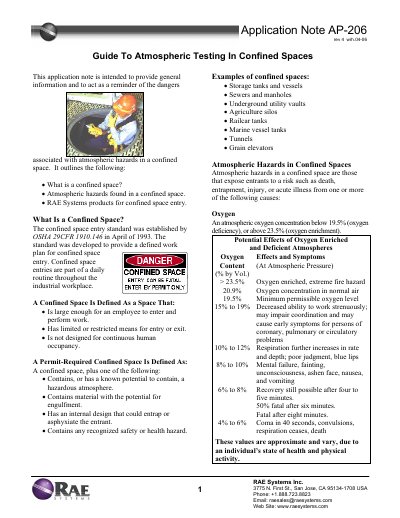
This document serves as a guide to atmospheric testing in confined spaces, outlining the definition of confined spaces, atmospheric hazards such as oxygen deficiency, combustible gases, and toxic gases, and the associated safety risks. It details the effects of exposure to specific gases like carbon monoxide and hydrogen sulfide.
The note also describes RAE Systems' product line designed for confined space entry, including the Q-RAE, MultiRAE, VRAE, and ToxiRAE monitors. It explains how these devices measure oxygen, combustible gases, and toxic gases with preset alarms to comply with OSHA standards.
| Minimum permissible oxygen level | 19.5% |
|---|---|
| Maximum permissible oxygen level | 23.5% |
| Combustible gas alarm (low) | 10% LEL |
| Combustible gas alarm (high) | 20% LEL |
| H2S low alarm | 10 ppm |
| H2S high alarm | 20 ppm |
| CO low alarm | 35 ppm |
| CO high alarm | 200 ppm |
A space that is large enough for an employee to enter and perform work, has limited or restricted means for entry or exit, and is not designed for continuous human occupancy.
The lowest concentration of an air-fuel mixture at which a gas can ignite; concentrations below this limit are too lean to burn.